Author Guidelines & Publication Ethics
Strict peer-review benchmarks, double-blind evaluation protocols, plagiarism prevention, and comprehensive submission guidelines for researchers and authors participating in COAIEMA-2028.

Ethical standards, peer-review workflow, and comprehensive guidelines for authors participating in COAIEMA-2028.
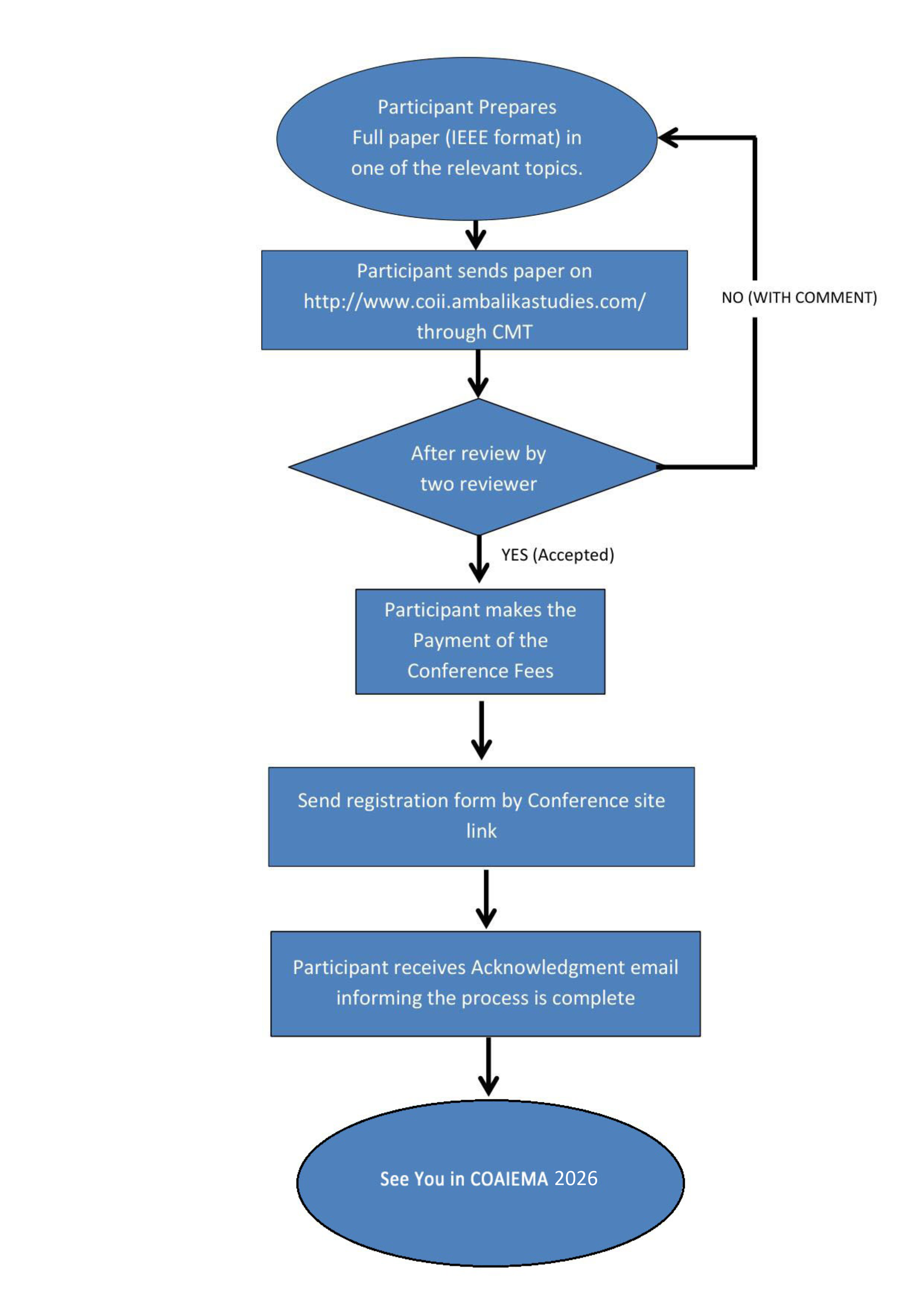
Selection of papers for presentation and publication will be based on detailed Abstract (Limit 250 words), a maximum of Six keywords and full paper (MS word) in IEEE Double column format. These will be submitted on “Microsoft Conference management Toolkit” through paper submission link on http://www.aimt.edu.in/Conference. The research paper not to exceed more than 6 pages. Please check for plagiarism before submission. Submitted paper will be reviewed and only those papers approved by the reviewers will be selected for participation and publication. The registration fees will be submitted through online banking/UPI and fill the registration form after payment through link given on conference site. Each author has to individually register to attend/participate and avail the Conference kit otherwise it will be provided to the registered authors only. All rights of publication of papers prescribed in the Conference will be with the Conference organizers.
Authors can also send their research papers directly to email ID{' '} editor.coii@ambalika.co.in {' '} with relevant documents.
Selected papers will be published in reputed SCOPUS Index Journals / conference proceedings.
Remaining full length papers will be published in the form of chapters in edited book and proceedings with ISBN number after review.
Best Paper Presentation award will be given as per the judgement of the COAIEMA-2028 panel.
Student Project / Poster Competition with awards for outstanding student research.
The Challenges & Opportunities in Artificial Intelligence: Engineering & Management Applications conference (COAIEMA-2028) is committed to maintaining the highest ethical standards in research and publication. Authors submitting papers must adhere to the following ethical guidelines:
All submitted work must be original. Plagiarism, including self-plagiarism, is strictly prohibited. Authors should ensure proper citation of sources and references to avoid any form of academic misconduct.
Authors should not submit the same paper to multiple conferences or journals simultaneously. Papers should not be under review for other publications at the time of submission.
Authors must disclose any potential conflicts of interest that could influence their research or its presentation. This includes financial, personal, or professional relationships with other researchers or organizations.
Authors should ensure that all data presented in the paper are accurate and that methods and results are reported truthfully. Fabrication, falsification, or manipulation of data will result in the rejection of the paper and may lead to further action.
Only those who have made significant contributions to the research should be listed as authors. All authors must approve the final version of the paper and be accountable for its content.
Research involving human participants must comply with applicable laws and ethical standards, including obtaining informed consent when necessary. Ethical approval for studies should be mentioned in the paper.
All papers will undergo a double-blind peer review to ensure fairness and transparency. Reviewers are expected to evaluate submissions objectively and without bias. Authors should not attempt to influence the review process.
Authors are expected to address reviewers' comments and make revisions as required. Submitting revised papers that do not address the reviewers' concerns may lead to rejection.
Any violations of the above ethical guidelines, including but not limited to plagiarism, falsification of data, or unethical behavior during the review process, will be considered as academic malpractice and will result in immediate rejection of the paper. In cases of serious misconduct, the author(s) may be barred from future submissions.