
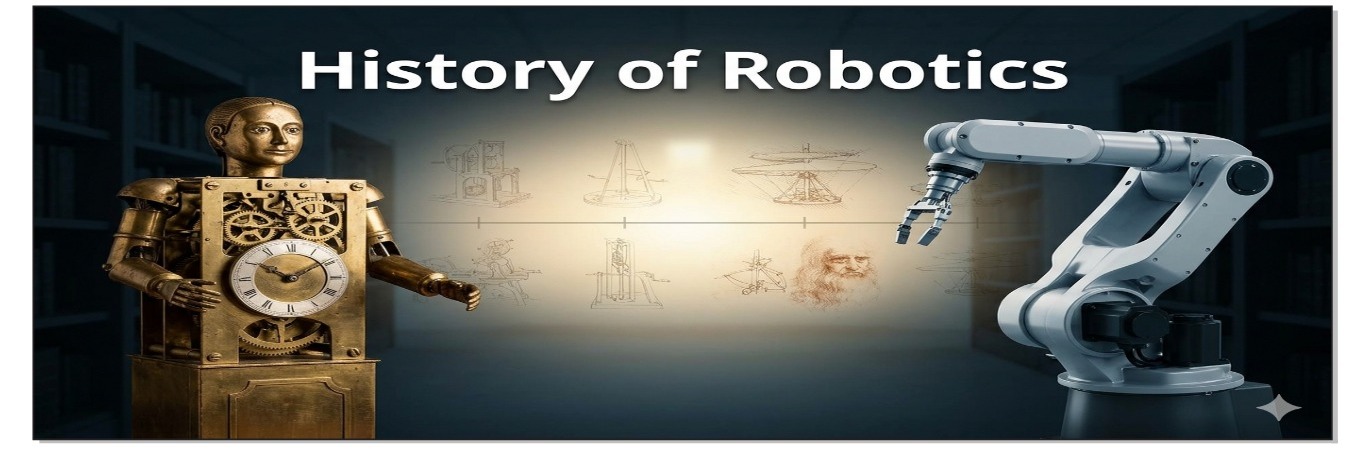
Did you ever wonder how Robotics emerged? What were the first Robots, and where? What is Physical AI and how does it relate to robots today? Well, the term ‘robot’ was coined by the Czech writer Karel Čapek in his play R.U.R. (Rossum’s Universal Robots). Pre-1950 was the era of ‘conceptual’ robotics, with Isaac Asimov introducing the “Three Laws of Robotics” in his short story Runaround. In 1949, the British neurobiologist and cybernetics pioneer William Grey Walter created the first autonomous electronic robots, “Elsie” and “Elmer,” which could find their way to a charging station.
This ushered what is called the Industrial Era of Robotics (roughly 1950s–1990s), which marked the period of transition of robotics from science fiction and laboratory experiments into essential tools for global manufacturing. It started with George Devol and Joseph Engelberger designing a ‘programmable arm’ called Unimate, which was installed at a General Motors plant in New Jersey. Engelberger is often called the Father of Robotics. The Unimate helped lift hot pieces of die-cast metal and stack them, a job which was very dangerous for human workers because of the extreme heat and noxious fumes.
Early robots in the Industrial era like the Unimate were powered by hydraulics, which were bulky, messy and prone to leaks. In 1969, the Stanford Arm was created by Victor Scheinman. This was the first all-electric, 6-axis robotic arm. This marked the transition of robots from hydraulics to electricity. Electric robots were smaller, faster, and much cleaner, allowing robots to move into “drier” indoor environments and perform more delicate assembly tasks.
The 1980s were the ‘Golden Age’ of Industrial expansion, Robots became the backbone of the global automotive and electronics sectors. Japan became the world leader in robotics during this decade, with companies like Fanuc, Yaskawa, and Kawasaki refining robots with greater complexity and sensor integration to make them more reliable and affordable for factories worldwide.
2000-2020 was what we can call the Mobile & Social Era of Robotics. In 2000, Honda unveiled ASIMO, the first humanoid robot capable of walking and interacting with people. This was followed by the release of the famous Roomba in 2002, bringing autonomous robotics into millions of homes. The Robot Operating System (ROS) was released in 2009, creating a universal language for robot developers, and in 2011, Robonaut 2 was launched to the International Space Station, becoming the first humanoid in space.
2021 – 2026 has been the Intelligent Era of Robotics. In 2023, Generative AI began to merge with robotics, allowing robots to understand complex natural language instructions. In 2025, ‘Physical AI’ became the industry standard. Large Language Models (LLMs) were integrated into robot “brains,” enabling them to learn by watching videos or being guided by humans.
Physical AI (also known as Embodied AI) is defined as artificial intelligence that has a “body” to interact with the real world. An analogy to explain Physical AI would be the difference between a chatbot that can write a perfect recipe for a cake and a robot that can actually crack the eggs, whisk the whites, and sense the oven’s heat to bake it. If traditional AI (like a chatbot) is a “brain in a jar” that only processes digital information, Physical AI is a “brain with muscles,” capable of perceiving, reasoning, and acting.
The Core Capabilities of Physical AI systems, unlike standard automation, are that they operate through a continuous Perception-Action Loop: using advanced sensors, they can “see” and “feel” the environment, use Vision-Language-Action (VLA) models to understand context and execute precise movements via actuators (robot arms, legs, or wheels).
The three major breakthroughs in Physical AI are:
- AI now has a “common sense” understanding of physics. It “knows” that objects fall, glass shatters, and surfaces can be slippery.
- Robots are trained in high-fidelity simulations where they “practice” a task millions of times in a virtual world before they ever attempt it in reality, reaching up to 99% accuracy on day one.
- We have moved from single-task machines (like a welding arm) to general-purpose bodies like humanoid robots that can be “taught” almost any human task.