
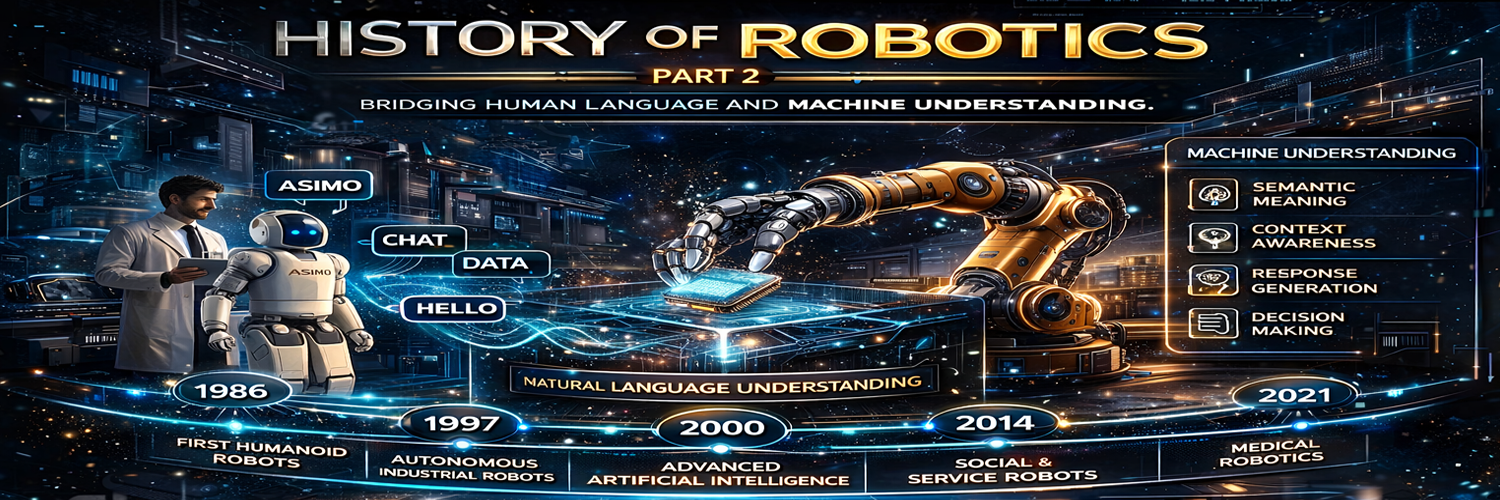
Welcome back to our journey of the evolution of robotics. In Part 1of this blog, we explored the mechanical roots and the initial industrial boom. In Part 2, we step into the most transformative chapter: the transition from machines that merely “moved” to machines that “reason.” As of 2026, we have officially entered the age of Physical AI and Agentic Robotics.
The Four Eras of Robotics
Let us briefly recap the history of Robotics divided into four eras; from basic movement to sophisticated human like reasoning:
The Mechanical Era: Mastering Motion
The foundation of robotics was laid during the Mechanical Era, where the primary focus was on physical motion. The goal was to create machines that could perform repetitive physical tasks with precision. The biggest achievement of this period was the development of programmable arms, most notably the Unimate in 1961, which revolutionized factory assembly lines by replacing manual labor in high-risk environments.
The Sensory Era: Gaining Awareness
As technology progressed, the focus shifted toward Awareness during the Sensory Era. Engineers began integrating hardware that allowed machines to “feel” and “see” their surroundings. The key achievement of this era was the introduction of vision and proximity sensors, enabling robots to detect obstacles and handle objects with a degree of environmental sensitivity that was previously impossible.
The Cognitive Era: Empowering Decision-making
With the rise of more powerful processors, the Cognitive Era emerged, centering on Decision-making. Robots were no longer just moving or sensing; they were calculating the best way to interact with the world. This era is best defined by the achievement of autonomous path planning, a technology brought into millions of homes through the popular Roomba vacuum, which could navigate complex floor plans without human intervention.
The Agentic Era: The Age of Reasoning
At present we are in the Agentic Era, where the focus has matured into true Reasoning. Unlike previous generations that followed strict “if-then” rules, modern robots possess Physical AI, allowing them to understand intent, interpret context, and self-correct their mistakes in real-time. These “agentic” machines act less like tools and more like coworkers, capable of navigating the “messy” reality of human environments autonomously.
Here are the major developments in the 21st century:
2000–2020: The Mobile & Social Revolution
The turn of the millennium shifted robots out of factory cages and into our lives. In 2000, Honda’s ASIMO showed a humanoid could walk and interact. By 2002, the Roomba made household robotics a reality. This era was defined by the birth of ROS (Robot Operating System) in 2009—a universal language that allowed developers worldwide to collaborate. In 2011, a humanoid named Robonaut 2 was sent to the International Space Station, proving that humanoids could handle the rigors of orbit quite like human astronauts.
2021–2026: The Rise of Physical AI
This “Intelligent Era” began with a fusion of Generative AI and hardware. In 2025, Physical AI became the gold standard. Unlike “Digital AI” (like ChatGPT), which lives behind a screen, Physical AI gives a robot “common sense” about gravity, friction, and texture.
From “Scripts” to “Reasoning”
Traditional robots followed strict scripts. The robot failed if there was any deviation from the script. Today’s Agentic Robots act like coworkers, with their brains being Vision-Language-Action (VLA) models. VLAs are bridges between Large Language Models (like the one used by Google Gemini) and Physical Robotics. These represent a major leap in artificial intelligence. Essentially, they are the “brains” that allow a robot to look at the world, understand a verbal command, and then physically move to execute that command. An example of VLA is a robot being able to identify a “blue cup” on a “wooden table,” understanding natural language instructions like, “Pick up the blue cup and bring it to me,” and being able to translate “pick up the cup” into specific motor commands—how much to rotate a joint, how wide to open a gripper, and how much force to apply.
The 2026 Global Powerhouse Leaders
- China (The Volume Leader): China is currently the hub for mass-producing humanoid hardware at low costs.
- South Korea (The Automation Champion): South Korea has a staggering 1,012 robots per 10,000 workers, making it is the most “robotized” society on Earth.
- United States (The Intelligence Leader): The U.S. leads in Physical AI and reasoning software developed by labs like Google DeepMind and OpenAI.
- Japan (The Precision King): Companies like Fanuc and Yaskawa still produce over 50% of the world’s high-end industrial components.
Where is India placed in the global ranking?
India has climbed to 6th place globally, driven by “Bot-Valleys” in Noida (Addverb) and Gurugram (GreyOrange), focusing on “Sovereign AI” and warehouse automation.
The “Big Five” Humanoids of 2026
These models are no longer laboratory experiments; they are actively being deployed:
- Electric Atlas (Boston Dynamics): Features 360° rotational joints, allowing it to move in ways humans can’t.
- Optimus Gen 3 (Tesla): Deeply integrated with Tesla’s FSD (Full Self-Driving) brain for mass manufacturing.
- Figure 02: Partnered with OpenAI for incredible conversational and reasoning abilities.
- NEO (1X): A lightweight, quiet humanoid designed specifically for safe interaction in homes.
- Unitree G1: A high-speed, “Kung Fu” agile robot from China, leading in cost-effectiveness ($16,000).
New Specialized Roles for Robotics in 2026:
- Robotics Safety Engineer: Ensuring “Cobots” (collaborative robots) work safely alongside humans.
- Digital Twin Engineer: Building virtual replicas of factories.
- Humanoid Deployment Expert: Managing the “onboarding” of robots into human spaces.
Conclusion
The history of robotics has officially moved from science fiction to industrial application. There is a concern that robots are replacing humans, but we are actually multiplying human capability. As robots gain “agency,” they become our allies in solving the world’s most complex challenges—from precision surgery to sustainable manufacturing.