
 Introduction
The construction industry is continuously evolving to improve the durability, efficiency, and sustainability of building materials. One of the most important processes affecting concrete performance is curing, which ensures proper hydration of cement and development of strength. Traditionally, curing is achieved through external methods such as ponding, spraying water, or using wet coverings. However, these approaches are often difficult to maintain in hot climates, remote locations, and water-scarce regions.
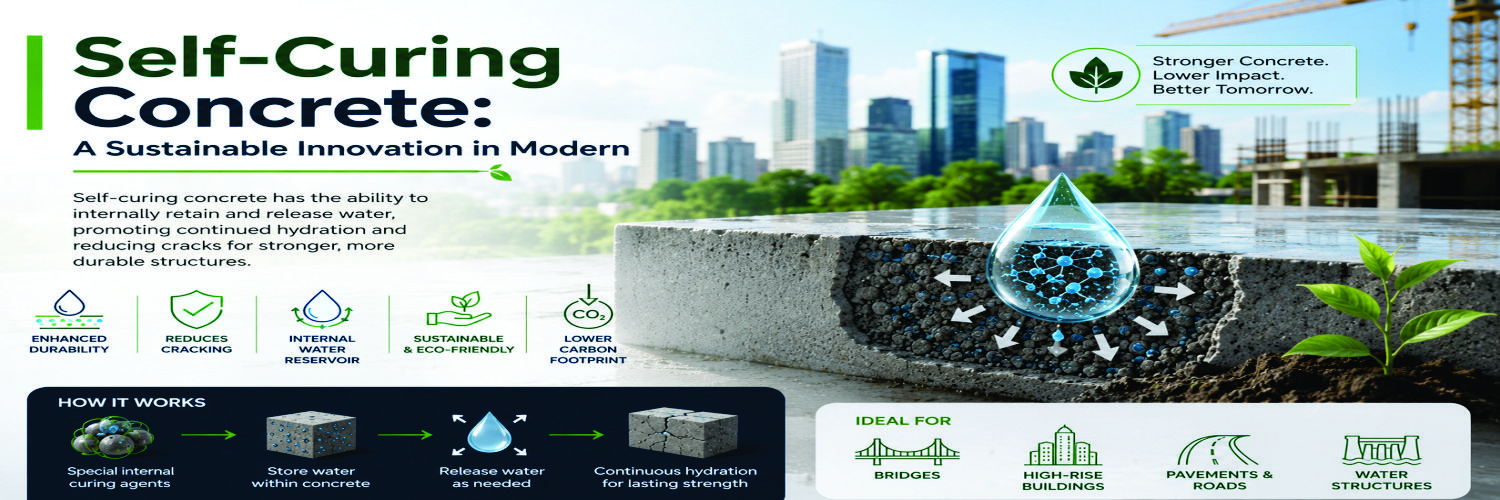
To address these challenges, self-curing concrete has emerged as an innovative solution. Also known as internally cured concrete, it incorporates materials that retain and gradually release water within the concrete matrix. This internal moisture supply ensures continuous hydration, even when external curing is insufficient or absent. As a result, self-curing concrete improves strength development, reduces shrinkage, and enhances long-term durability while reducing dependence on external water resources.
Concept of Self-Curing Concrete
Self-curing concrete is designed to retain internal moisture throughout the hydration process of cement. The primary goal is to ensure that sufficient water remains available for complete hydration, especially in mixes with low water-cement ratios where internal drying can occur rapidly.
Cement hydration produces calcium silicate hydrate (C–S–H), the main compound responsible for concrete strength and durability. In conventional concrete, incomplete hydration due to water loss leads to shrinkage, cracking, and reduced performance. Self-curing concrete addresses this issue by incorporating internal reservoirs of water that release moisture gradually over time, supporting continuous hydration and improving microstructure formation.
Working Mechanism
The functioning of self-curing concrete is based on two key processes:
- Absorption of water by internal curing materials during mixing
- Controlled release of stored water during hydration
Materials used in self-curing concrete are typically porous or highly hydrophilic. During mixing, they absorb water and store it within their internal structure. As hydration progresses and the concrete begins to dry internally, these materials release the stored water into the surrounding cement paste.
This mechanism maintains internal relative humidity and ensures that hydration continues even under drying conditions. The result is a more complete hydration process, leading to improved strength and reduced microcracking.
Materials Used in Self-Curing Concrete
Polyethylene Glycol (PEG)
Polyethylene glycol is a water-retaining chemical that reduces evaporation within the concrete mix. It forms hydrogen bonds with water molecules, helping retain moisture for a longer duration. PEG improves hydration efficiency and contributes to reduced permeability and improved resistance to environmental attack.
Superabsorbent Polymers (SAPs)
SAPs are highly absorbent materials capable of retaining large quantities of water relative to their mass. In concrete, they function as micro-reservoirs that release water gradually as hydration proceeds. SAPs are particularly effective in low water-cement ratio mixes, where they significantly reduce autogenous shrinkage and early-age cracking.
Lightweight Aggregates (LWA)
Lightweight aggregates such as expanded clay, shale, and perlite have a porous structure that allows them to absorb and store water. These aggregates release water slowly into the cement matrix during hydration. LWAs are especially useful in mass concrete applications, where temperature control and shrinkage reduction are critical.
Supporting Chemical Admixtures
Shrinkage-Reducing Admixtures (SRAs)
SRAs reduce surface tension in the pore water, thereby decreasing internal stresses that lead to shrinkage and cracking.
Water-Retaining Admixtures (WRAs)
WRAs slow down evaporation and help maintain internal moisture levels during the early curing stages.
Viscosity Modifying Agents (VMAs)
VMAs improve mix stability, prevent segregation, and ensure uniform distribution of internal curing materials within the concrete.
Advantages of Self-Curing Concrete
Reduced Shrinkage and Cracking
By maintaining internal moisture, self-curing concrete minimizes both plastic and autogenous shrinkage. This significantly reduces the risk of early-age cracking, which is a common issue in conventional concrete.
Improved Strength and Durability
Continuous hydration leads to a denser microstructure with increased formation of C–S–H gel. This improves compressive strength, reduces permeability, and enhances resistance to chemical and environmental degradation.
Reduced Dependence on External Curing
Self-curing concrete requires less external water application, reducing labor, monitoring efforts, and water consumption. This makes it particularly suitable for regions where traditional curing is difficult.
Sustainability Benefits
By reducing water usage and improving structural lifespan, self-curing concrete supports sustainable construction practices and reduces long-term maintenance requirements.
Limitations
Higher Initial Material Cost
The use of specialized materials such as SAPs, PEG, and lightweight aggregates increases the initial cost of production. However, these costs may be offset by reduced maintenance and longer service life.
Workability Concerns
If not properly proportioned, internal curing materials can affect workability and make concrete placement more challenging. Additional admixtures may be required to maintain consistency.
Sensitivity to Mix Design
The performance of self-curing concrete depends heavily on accurate dosage and mix design. Improper proportions may lead to excessive voids or insufficient curing effectiveness.
Applications
Precast and Prestressed Concrete
Self-curing concrete is suitable for precast elements where controlled curing conditions and rapid strength development are required.
Pavements and Infrastructure
It is used in roads, airports, and industrial flooring, especially in dry and hot regions where water availability is limited.
Mass Concrete Structures
In large structures such as dams and foundations, self-curing concrete helps control thermal cracking and shrinkage issues.
Water-Retaining Structures
It is highly effective in reservoirs, tanks, and sewage systems due to its improved impermeability and crack resistance.
Discussion
Self-curing concrete represents a significant advancement in concrete technology by addressing the limitations of external curing methods. Its ability to maintain internal hydration improves both mechanical and durability properties. However, widespread adoption depends on further optimization of material costs, standardized mix design procedures, and increased field validation through long-term performance studies.
Conclusion
Self-curing concrete offers a practical and sustainable alternative to conventional curing methods. By enabling internal water retention and controlled moisture release, it enhances hydration, reduces shrinkage, and improves durability. While challenges such as cost and mix sensitivity remain, its long-term benefits make it a promising material for modern infrastructure development. As sustainability becomes a key priority in construction, self-curing concrete is expected to play an increasingly important role in future engineering practices.