
 Introduction
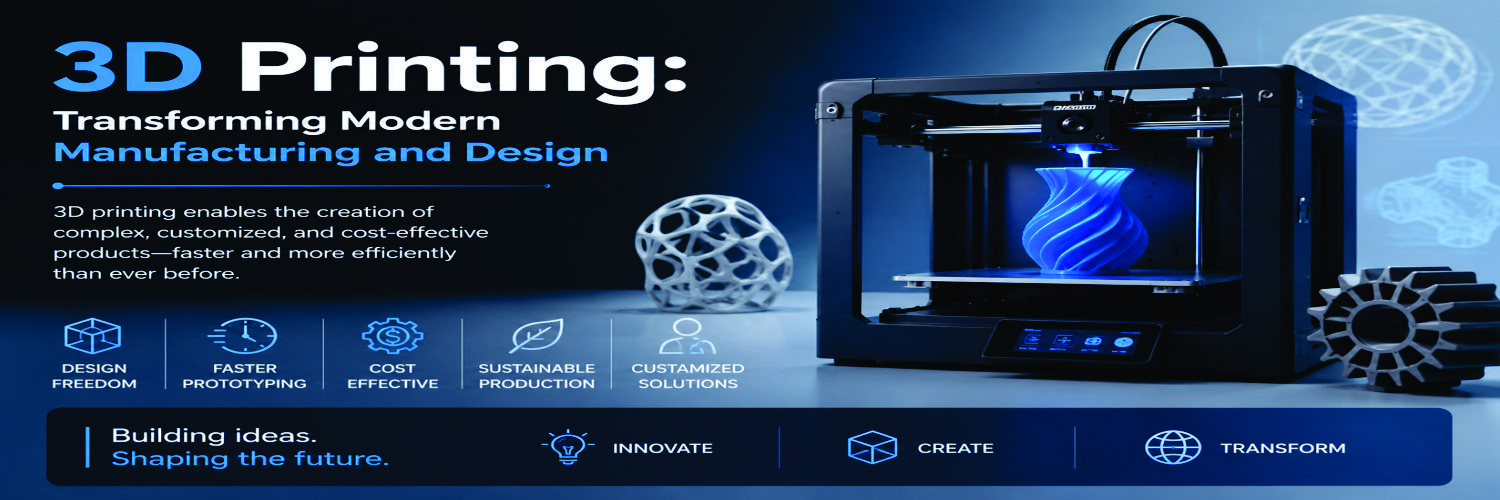
Mechanical engineering has always been at the core of industrial development, driving innovation in manufacturing, product design, and system optimization. In recent years, one of the most transformative technologies influencing this field is 3D printing, also known as additive manufacturing. Unlike conventional subtractive manufacturing processes, which remove material from a solid block, 3D printing builds objects layer by layer from digital models.
This technology has significantly changed how engineers design, prototype, and manufacture components. It enables faster development cycles, improved customization, and cost-effective production, making it a key reason why mechanical engineering remains one of the most dynamic and relevant engineering disciplines today.
Understanding 3D Printing in Mechanical Engineering
3D printing is a digital manufacturing process that converts computer-aided design (CAD) models into physical objects. The process begins with designing a component using CAD software, followed by slicing the model into thin layers using specialized software. These layers are then printed sequentially using materials such as polymers, metals, or composites.
This layer-by-layer fabrication allows engineers to create highly complex geometries that are often impossible or expensive to achieve using traditional manufacturing methods. As a result, mechanical engineers can experiment with innovative designs while reducing material waste and production time.
Advantages of 3D Printing in Engineering Design
One of the most significant benefits of 3D printing is rapid prototyping. Engineers can quickly convert ideas into physical models, test them, and refine designs within days instead of weeks or months. For example, an automotive engineer designing a new engine component can print multiple design iterations and evaluate performance before final production, significantly reducing development cycles.
Another major advantage is customization. 3D printing allows the production of components tailored to specific requirements without significantly increasing cost. In the medical field, for instance, customized prosthetics and surgical tools can be designed to match individual patient anatomy, improving comfort and treatment outcomes.
Cost efficiency is also a key factor. Since material is added only where needed, waste is minimized. Additionally, small-scale production becomes economically viable, which is particularly beneficial for startups and research-based industries.
Industrial Applications of 3D Printing
3D printing has found applications across multiple engineering domains:
In the healthcare sector, it is used to create customized implants, prosthetics, and surgical guides. For example, patient-specific dental implants and bone scaffolds are now commonly produced using additive manufacturing techniques.
In the automotive industry, companies use 3D printing for prototyping lightweight components and testing aerodynamic designs. This helps reduce vehicle weight, which in turn improves fuel efficiency and reduces emissions.
In the aerospace industry, 3D printing is used to manufacture complex components such as turbine blades and structural parts. These components benefit from reduced weight and improved strength-to-weight ratios, which are critical in flight performance.
In the construction industry, engineers use large-scale 3D printing to create architectural models and even structural elements. This allows better visualization of projects and reduces design errors before actual construction begins.
Consumer product companies also benefit by using 3D printing to develop customized household items, fashion accessories, and ergonomic product designs that improve user experience.
Key 3D Printing Technologies
Several advanced 3D printing technologies are used in mechanical engineering, each suited for different applications:
Powder Bed Fusion (PBF) is widely used for producing high-precision metal parts. It works by using a laser or electron beam to fuse powdered material layer by layer, making it ideal for aerospace and medical applications.
Selective Laser Sintering (SLS) is commonly used for producing durable plastic and metal components. It allows the creation of strong functional parts without requiring support structures.
Multi Jet Fusion (MJF) is known for its speed and precision in producing small to medium batch components. It is widely used in industrial prototyping and end-use parts manufacturing.
These technologies enable engineers to choose appropriate methods based on material requirements, cost constraints, and performance expectations.
Role of Digital Manufacturing and Simulation
Modern 3D printing is closely integrated with digital engineering tools. Before printing, engineers use simulation software to analyze how a component will behave under different conditions such as stress, temperature, and load. This reduces the risk of design failure and improves efficiency.
Additionally, automation in 3D printing systems allows for minimal human intervention, ensuring consistency and accuracy in production. This integration of design, simulation, and manufacturing is transforming mechanical engineering into a highly digital and intelligent discipline.
Challenges and Limitations
Despite its advantages, 3D printing has certain limitations. Material selection is still limited compared to traditional manufacturing methods, and production speed can be slow for large-scale manufacturing. Additionally, initial setup costs for industrial-grade printers remain high.
Another challenge is ensuring consistent mechanical strength in printed parts, especially for critical applications. Engineers must carefully optimize printing parameters such as temperature, layer thickness, and material composition to achieve desired performance.
Conclusion
3D printing has emerged as a revolutionary technology that is reshaping mechanical engineering. By enabling rapid prototyping, customization, and efficient material usage, it has significantly improved the design and manufacturing process. Industries such as healthcare, automotive, aerospace, and construction are already benefiting from its capabilities.
However, its full potential is still evolving as researchers continue to improve materials, printing techniques, and scalability. For aspiring mechanical engineers, understanding 3D printing is no longer optional—it is an essential skill that defines modern engineering practice.
In conclusion, mechanical engineering remains a highly relevant and future-ready field, and technologies like 3D printing are at the heart of its continuous transformation.