
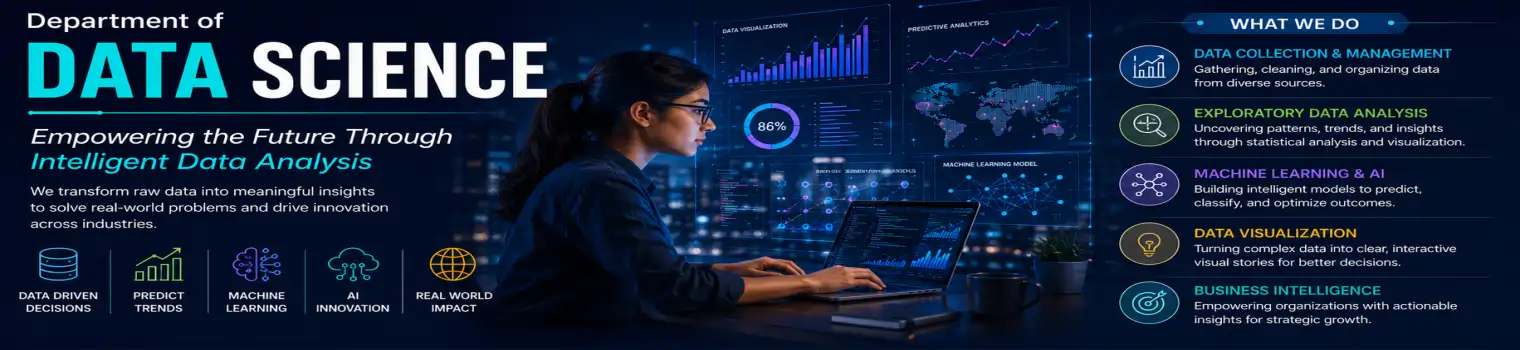
In today’s digital era, data has emerged as one of the most valuable resources shaping economies, industries, governments, and scientific advancement. Every online interaction, digital transaction, social media activity, and sensor-generated reading contributes to the vast and continuously expanding pool of information that surrounds us. However, data alone has little value unless it can be effectively interpreted and transformed into actionable insights. This is where Data Science plays a crucial role.
The Department of Data Science serves as a dynamic centre of learning and innovation dedicated to extracting meaningful knowledge from data. It integrates diverse disciplines such as mathematics, statistics, computer science, and domain-specific expertise to help organizations and societies make informed, evidence-based decisions. In today’s technology-driven world, Data Science has emerged as one of the most significant disciplines for addressing complex technological, industrial, and societal challenges.
The Rise of Data Science in the Digital Age
The modern world generates unprecedented volumes of both structured and unstructured data. Industries including healthcare, finance, agriculture, e-commerce, transportation, cybersecurity, manufacturing, education, and social media increasingly rely on data-driven insights to improve efficiency, enhance decision-making, and gain competitive advantages.
Data Science combines logical reasoning, computational power, statistical techniques, and predictive modelling to convert raw data into meaningful information. Through the use of machine learning algorithms, statistical analysis, data visualization techniques, and intelligent systems, data professionals can identify patterns, forecast outcomes, and solve complex real-world problems.
As organizations across the globe continue to embrace digital transformation, the demand for skilled data professionals has grown significantly. The Department of Data Science is committed to preparing graduates who possess strong analytical abilities, technical expertise, and the adaptability required to thrive in a rapidly evolving technological landscape.
Academic Excellence and Interdisciplinary Learning
One of the distinguishing features of the Department of Data Science is its interdisciplinary approach to education. Students not only develop technical competencies in programming and data analysis but also gain a strong foundation in mathematics, probability theory, statistics, business intelligence, and problem-solving methodologies.
A carefully designed curriculum ensures that students acquire both theoretical knowledge and practical implementation skills. Key areas of study typically include:
- Data Analytics
- Machine Learning
- Artificial Intelligence
- Statistical Modelling
- Data Visualization
- Big Data Technologies
- Cloud Computing
- Database Management Systems
- Predictive Analytics
- Deep Learning
- Business Intelligence
- Natural Language Processing
This comprehensive academic framework equips students with the knowledge and skills required to address diverse data-related challenges across industries.
The department places significant emphasis on experiential learning. Students actively participate in laboratory sessions, programming assignments, real-world case studies, industry projects, and collaborative research initiatives. Such practical exposure enables learners to apply theoretical concepts to solve meaningful social, industrial, and technological problems. By working with real datasets and analytical tools, students develop the confidence and competence required to excel in professional environments.
Research and Innovation in Emerging Technologies
Research and innovation are fundamental pillars of academic growth and technological progress. The Department of Data Science fosters a culture of inquiry by encouraging students and faculty members to engage in research activities that address emerging challenges and opportunities.
Data Science is increasingly being applied across a wide range of domains, including:
- Medical diagnosis and healthcare analytics
- Smart city development
- Financial forecasting and risk assessment
- Environmental monitoring and climate studies
- Cybersecurity intelligence
- Recommendation systems
- Intelligent transportation systems
- Social network analysis
- Agricultural optimization
Through interdisciplinary research initiatives, students gain valuable experience in designing algorithms, analyzing large datasets, and developing innovative solutions to real-world challenges.
The department also encourages students to publish research papers, participate in conferences, engage in innovation competitions, collaborate with industry professionals, and contribute to research-driven projects. Such experiences strengthen scientific thinking, creativity, and advanced problem-solving skills while fostering a spirit of lifelong learning and intellectual curiosity.
The Role of Faculty in Shaping Future Data Scientists
The quality of any academic department is greatly influenced by the dedication and expertise of its faculty members. In the Department of Data Science, faculty members serve not only as educators but also as mentors, researchers, and guides who inspire students to explore new ideas and pursue excellence.
Teaching Data Science requires balancing theoretical foundations with practical application. Faculty members must remain proficient in mathematical modelling, statistical analysis, programming frameworks, machine learning techniques, and modern data analytics tools.
To ensure academic relevance, educators continuously update their knowledge in response to emerging technologies, industry developments, and evolving research trends. This commitment helps students receive an education that aligns with contemporary professional and academic standards.
Faculty mentorship also plays a critical role in nurturing innovation, ethical awareness, teamwork, leadership, communication skills, and lifelong learning among students. Such guidance contributes significantly to the overall development of future professionals.
Industry Interaction and Career Opportunities
A major strength of the Department of Data Science lies in its strong engagement with industry. As organizations increasingly depend on data-driven strategies, the need for qualified data professionals continues to expand across sectors.
To bridge the gap between academic learning and professional practice, the department regularly organizes:
- Industrial internships
- Expert lectures and seminars
- Technical workshops
- Certification programs
- Hackathons and coding competitions
- Collaborative industry projects
These initiatives expose students to real-world data challenges, emerging technologies, and professional work environments. Industry interaction also helps students understand current market demands and develop skills that enhance their employability.
Graduates of the department can pursue rewarding careers in diverse roles, including:
- Data Analyst
- Data Scientist
- Machine Learning Engineer
- Business Intelligence Analyst
- Data Engineer
- Research Scientist
- Artificial Intelligence Specialist
- Quantitative Analyst
- Cybersecurity Analyst
- Cloud Data Architect
The interdisciplinary nature of Data Science ensures strong career prospects and long-term professional adaptability across multiple industries. As data continues to drive innovation and strategic decision-making, opportunities for qualified professionals are expected to expand further in the coming years.
Ethical Responsibility in Data Science
While Data Science presents immense opportunities for innovation and growth, it also raises important ethical considerations related to privacy, security, fairness, accountability, and transparency.
The misuse or misinterpretation of data can have significant consequences for individuals, organizations, and society. Recognizing this responsibility, the Department of Data Science emphasizes the ethical and responsible application of technology.
Students are encouraged to understand issues such as algorithmic bias, data privacy concerns, misinformation, cybersecurity risks, and responsible artificial intelligence. Ethical awareness is not merely an academic requirement but an essential professional obligation in today’s interconnected world.
Future data scientists must ensure that technological advancements remain transparent, secure, inclusive, and socially beneficial. By incorporating ethical principles into education and research, the department prepares graduates who can develop solutions that balance innovation with responsibility.
Conclusion
The Department of Data Science represents a modern academic ecosystem dedicated to innovation, analytical excellence, and technological advancement. By integrating mathematics, statistics, computing, and domain knowledge, the department equips students with the skills needed to address complex challenges in an increasingly data-driven world.
Beyond technical education, the department fosters research aptitude, ethical responsibility, critical thinking, creativity, and interdisciplinary collaboration. These qualities are essential for developing intelligent systems that create meaningful impact and contribute positively to society.
As technology continues to evolve at an unprecedented pace, the ability to transform vast amounts of information into actionable knowledge will become increasingly important. The future belongs to those who can convert data into insight, insight into innovation, and innovation into sustainable progress.
The Department of Data Science therefore stands as a centre of academic excellence and a gateway to the intelligent future of the digital age, preparing students to become capable professionals, responsible innovators, and leaders in the data-driven world of tomorrow.