
Introduction
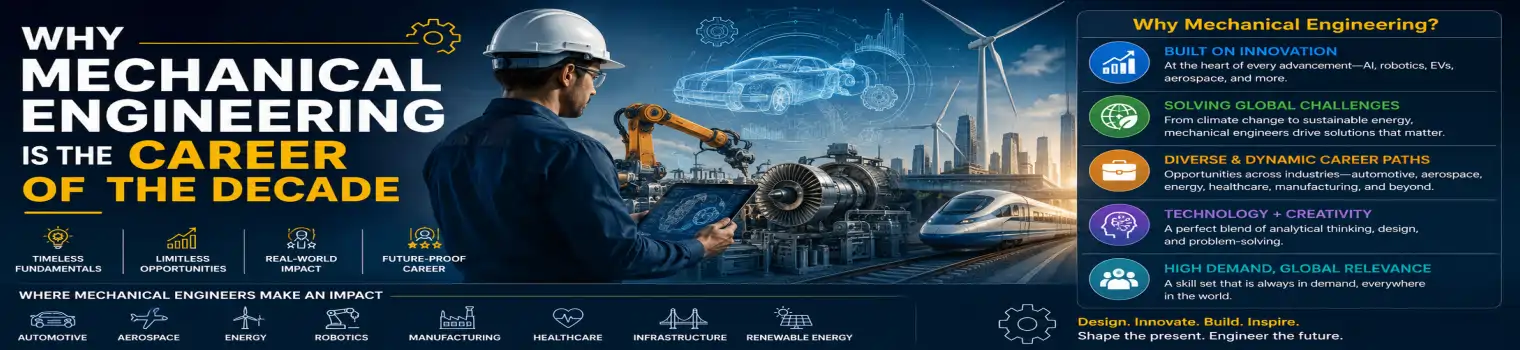
Mechanical engineering is one of the most established and essential engineering disciplines, yet it is undergoing rapid transformation in response to global challenges. By 2026, issues such as climate change, artificial intelligence integration, sustainable energy systems, and an ageing global population are reshaping the role of engineers across industries.
In this context, mechanical engineering emerges not only as a stable career choice but also as a highly dynamic and future-relevant profession. It offers opportunities to contribute directly to technological advancement, industrial development, and societal progress.
The Discipline That Runs the Physical World
Mechanical engineering involves the design, analysis, manufacturing, and improvement of physical systems and machines. It plays a central role in technologies ranging from automotive engines and industrial machinery to robotic systems and medical devices.
The discipline integrates physics, mathematics, and materials science to understand how forces, motion, heat, and fluids interact in engineered systems. This interdisciplinary foundation enables mechanical engineers to work across a wide range of industries and applications.
“Mechanical engineers do not just build machines. They build the capacity for human civilisation to function at scale.” — NATURE ENGINEERING, MARCH 2026
In 2026, mechanical engineering is undergoing significant evolution driven by digital twins, artificial intelligence-based design optimisation, additive manufacturing, and the electrification of transportation systems. These advancements are increasing both the complexity and value of the profession.
Six Reasons to Choose Mechanical Engineering Right Now
Mechanical engineering remains one of the most versatile and impactful disciplines due to the following key factors:
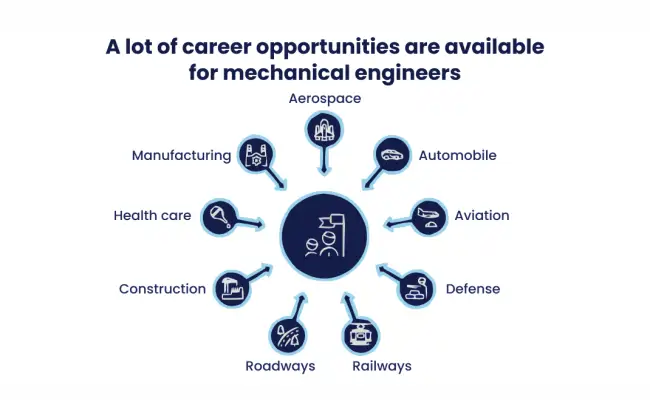
Unmatched versatility: One degree enables access to diverse industries such as aerospace, automotive, energy, robotics, biomedical engineering, HVAC, defence, and manufacturing.
Green energy transition: Mechanical engineers are central to designing renewable energy systems including wind turbines, hydrogen fuel cells, EV powertrains, and solar technologies.
AI–physical systems integration: Artificial intelligence requires physical execution systems such as sensors, actuators, and robotics, creating strong demand for hybrid “Mech-AI” expertise.
Entrepreneurial opportunities: India’s deep-tech startup ecosystem in drones, EVs, space technology, and robotics is increasingly driven by mechanical engineers.
Global mobility: The discipline is internationally recognised, with strong demand in countries such as Germany, Canada, the UAE, Japan, and Australia.
Tangible impact: Mechanical engineers design physical systems that directly affect daily life, from infrastructure to healthcare devices, offering visible and meaningful outcomes.
Career Paths: Where Do Mechanical Engineers Work
Mechanical engineering provides access to a wide range of career opportunities across industries.
Design Engineer (₹6L–₹18L/year): Develops CAD models and engineering specifications for manufacturing and product development.
Robotics Engineer (₹10L–₹30L/year): Designs, develops, and programs robotic systems used in automation, healthcare, logistics, and industry.
Aerospace Engineer (₹8L–₹25L/year): Works on aircraft, spacecraft, propulsion systems, and aviation technologies.
EV / Energy Engineer (₹9L–₹28L/year): Develops electric mobility systems, battery technologies, and renewable energy solutions.
Biomedical Engineer (₹7L–₹22L/year): Designs medical devices such as prosthetics, implants, surgical robots, and diagnostic systems.
Manufacturing / Process Engineer (₹5L–₹16L/year): Optimises production systems, quality control processes, and industrial efficiency.
The Skills That Will Define Success in 2026
Modern mechanical engineering requires a combination of traditional engineering knowledge and advanced digital competencies.
→ CAD & Simulation (FEA/CFD): Tools such as SolidWorks, ANSYS, CATIA, and AutoCAD remain essential for design and analysis.
→ Python & MATLAB: Programming skills are increasingly required for data analysis, automation, and control systems.
→ Additive Manufacturing: 3D printing and design-for-manufacturing principles are now core industry requirements.
→ Thermo-fluids & Energy Systems: Expertise in heat transfer and fluid mechanics is increasingly valuable due to the global energy transition.