Introduction
Artificial Intelligence (AI) is advancing at an extraordinary pace, reshaping how humans live, work, and interact with technology. While traditional AI systems have demonstrated strong capabilities in data analysis, automation, and content generation, the next major leap is Agentic AI.
Agentic AI marks a fundamental shift from systems that simply respond to prompts toward intelligent agents that can independently plan, reason, and act to achieve defined goals. This evolution is not just incremental—it represents a structural transformation in how AI systems operate.
With growing demand for automation, efficiency, and intelligent decision-making, Agentic AI is rapidly becoming a key pillar of the future digital ecosystem. It holds the potential to revolutionize industries, enhance productivity, and redefine human–machine collaboration.
Understanding Agentic AI
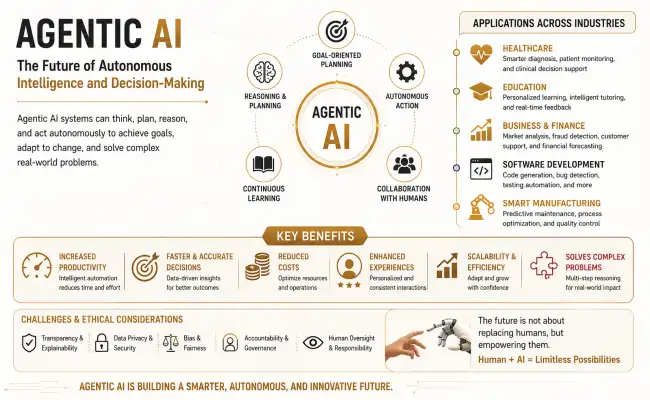
Agentic AI refers to artificial intelligence systems capable of autonomous operation through decision-making, task execution, and adaptive learning based on changing environments.
Unlike conventional AI tools that require continuous human input, Agentic AI can independently determine the steps needed to achieve a specific objective. These systems integrate advanced machine learning, natural language processing, reasoning models, and structured decision-making frameworks.
Instead of producing a single output, an AI agent can:
- Analyze a problem
- Gather relevant information
- Develop a step-by-step plan
- Execute multiple actions
- Monitor progress and adjust strategies in real time
This makes Agentic AI more of a proactive digital collaborator than a passive tool.
Key Features of Agentic AI
Autonomous Decision-Making
Agentic AI can assess situations, interpret data, and make informed decisions without constant human supervision.
Goal-Oriented Planning
These systems work toward clearly defined objectives by breaking complex tasks into structured, manageable steps.
Continuous Learning
Through feedback and experience, Agentic AI improves its performance over time and adapts to new scenarios.
Multi-Step Reasoning
Unlike traditional models that generate single responses, AI agents can perform sequential reasoning and coordinate multiple interconnected tasks.
Human Collaboration
Agentic AI is designed to work alongside humans, enhancing decision-making, automating workflows, and supporting problem-solving processes.
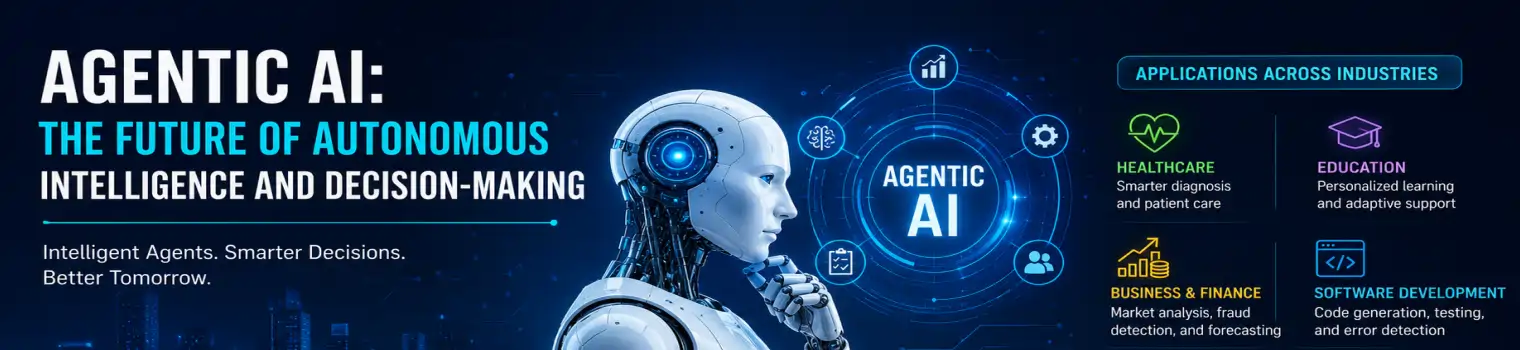
Applications Across Industries
Healthcare
AI agents assist in analyzing patient records, tracking health conditions, scheduling appointments, and supporting clinical decisions, improving efficiency and accuracy in healthcare delivery.
Education
In education, Agentic AI enables personalized learning systems that adapt content to student needs, provide real-time feedback, and enhance overall learning outcomes.
Business and Finance
Organizations use AI agents for market research, fraud detection, customer service automation, financial forecasting, and operational optimization.
Software Development
AI-powered assistants can generate code, detect errors, automate testing, and significantly speed up software development cycles.
Smart Manufacturing
In manufacturing environments, Agentic AI monitors equipment, predicts maintenance needs, optimizes production schedules, and improves operational efficiency.
Benefits of Agentic AI
The adoption of Agentic AI brings several significant advantages:
- Higher productivity through intelligent automation
- Faster and more accurate decision-making
- Reduced operational costs
- Enhanced customer experience
- Improved resource utilization
- Greater scalability and operational efficiency
- Strong support for complex problem-solving
By automating repetitive and time-intensive tasks, Agentic AI allows individuals and organizations to focus more on innovation, creativity, and strategic growth.
Challenges and Ethical Considerations
Despite its potential, Agentic AI introduces several important challenges that must be addressed responsibly.
Transparency and Explainability
It is essential that users understand how AI agents make decisions and reach conclusions.
Data Privacy and Security
As AI systems handle increasing volumes of sensitive data, strong safeguards are required to ensure privacy and security.
Bias and Fairness
Training data must be diverse and representative to reduce bias and ensure fair outcomes.
Accountability
Clear governance frameworks are needed to define responsibility for actions taken by autonomous systems.
Human Oversight
Even though Agentic AI can operate independently, human supervision remains critical for safety, control, and ethical compliance.
The Road Ahead
The future of Agentic AI is highly promising. Rapid advancements in large language models, multimodal systems, reinforcement learning, and intelligent automation are accelerating the development of more capable AI agents.
In the coming years, AI agents are expected to become trusted collaborators across workplaces, classrooms, hospitals, and research environments. Rather than replacing humans, they will augment human intelligence—enabling people to focus on higher-value, creative, and strategic tasks.
Organizations that begin exploring and adopting Agentic AI today will be better positioned to succeed in an increasingly intelligent and automated future.
Conclusion
Agentic AI represents the next major evolution in artificial intelligence—moving beyond basic automation toward fully autonomous intelligence and decision-making systems. By combining reasoning, planning, learning, and execution, these intelligent agents are set to transform industries and redefine problem-solving at scale.
As this technology continues to evolve, Agentic AI will play a central role in building smarter systems, improving productivity, and enabling innovative solutions to complex global challenges. The future will be shaped not only by intelligent machines but by the powerful collaboration between human creativity and autonomous AI systems.