 Introduction
Cloud computing has become the foundation of the modern digital economy, enabling organizations across industries to innovate, scale, and operate efficiently. Over the past decade, it has transformed how data, applications, and IT infrastructure are managed.
As we move through 2026, cloud computing continues to evolve rapidly, driven by advancements in Artificial Intelligence (AI), cybersecurity, edge computing, and sustainability initiatives. Today, organizations are no longer questioning whether to adopt cloud technologies, but how to optimize and expand their use effectively.
The future of IT infrastructure is increasingly cloud-centric, offering greater flexibility, scalability, automation, and intelligence. This article explores the key trends shaping cloud computing in 2026 and their impact on the future of Information Technology.
Evolution of Cloud Computing
Cloud computing has evolved from basic storage and hosting services into advanced platforms that support application development, data analytics, machine learning, cybersecurity, and enterprise-scale digital transformation.
Modern cloud systems provide on-demand access to computing resources, eliminating the need for heavy physical infrastructure. This shift has enabled organizations to respond faster to market demands, improve operational efficiency, and accelerate innovation at scale.
Key Cloud Computing Trends in 2026
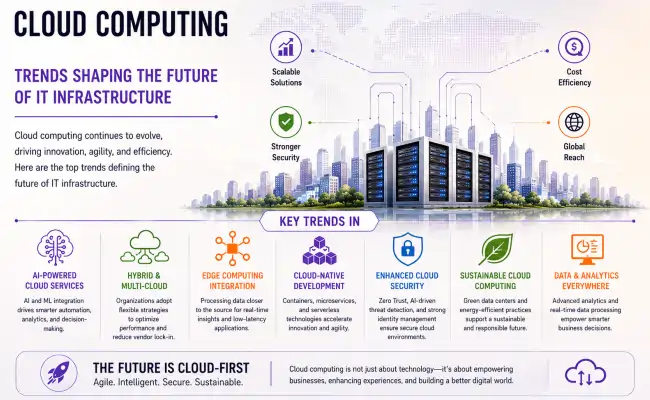
- AI-Powered Cloud Services
Artificial Intelligence is now deeply integrated into cloud platforms. Cloud providers offer AI-driven tools for automation, predictive analytics, monitoring, and decision support.
Key capabilities include:
- Automating IT operations
- Processing large-scale data in real time
- Enhancing customer experiences
- Improving forecasting and decision-making
AI and cloud integration are creating more autonomous and intelligent digital ecosystems.
- Multi-Cloud and Hybrid Cloud Strategies
Organizations are increasingly adopting multi-cloud and hybrid cloud models to improve flexibility, resilience, and control.
- Multi-cloud uses services from multiple providers
- Hybrid cloud combines private and public cloud environments
Key benefits include:
- Reduced vendor dependency
- Improved disaster recovery
- Stronger security and compliance
- Better workload distribution
These models are becoming standard practice for modern enterprises.
- Edge Computing Integration
The growth of IoT devices, smart cities, and connected systems is driving the adoption of edge computing.
Instead of sending all data to centralized cloud servers, edge computing processes data closer to its source, reducing latency and improving real-time performance.
Common applications include:
- Autonomous vehicles
- Smart manufacturing
- Healthcare monitoring
- Industrial automation
The combination of cloud and edge computing enables faster and more efficient data processing.
- Cloud-Native Application Development
Cloud-native development is reshaping how applications are designed and deployed. These applications are built specifically for cloud environments, ensuring scalability and resilience.
Key technologies include:
- Containers
- Microservices
- Kubernetes
- Serverless computing
This approach enables faster deployment cycles, improved system reliability, and more efficient resource utilization.
- Enhanced Cloud Security and Zero Trust Architecture
With increasing cyber threats, cloud security remains a top priority.
Organizations are adopting the Zero Trust model, which follows the principle: “never trust, always verify.”
Key security practices include:
- AI-driven threat detection
- Continuous authentication
- Advanced encryption
- Identity and access management
- Automated security monitoring
These measures strengthen protection and ensure regulatory compliance.
- Sustainable and Green Cloud Computing
Sustainability is becoming a core focus in cloud infrastructure development.
Cloud providers are investing in:
- Renewable energy-powered data centres
- Energy-efficient infrastructure
- Carbon-neutral operations
- Sustainable cooling technologies
Green cloud computing helps reduce environmental impact while supporting organizational sustainability goals.
- Cloud-Based Data Analytics and Business Intelligence
Data is now a critical business asset, and cloud platforms enable powerful analytics capabilities at scale.
Modern systems support:
- Real-time analytics
- Predictive modelling
- Data visualization
- Machine learning integration
These tools help organizations make faster, more informed, and data-driven decisions.
Benefits of Cloud Computing
Modern cloud infrastructure provides significant advantages:
- High scalability and flexibility
- Cost efficiency
- Improved collaboration
- Business continuity and reliability
- Faster innovation cycles
- Global accessibility
- Enhanced operational efficiency
Challenges in Cloud Adoption
Data Privacy and Compliance
Organizations must ensure compliance with data protection regulations across regions.
Cybersecurity Risks
Cloud environments remain vulnerable to evolving cyber threats.
Skill Gaps
Advanced cloud systems require trained professionals with specialized expertise.
Vendor Lock-In
Over-dependence on a single provider can limit flexibility and increase long-term costs.
Future of Cloud Computing
Cloud computing will continue to evolve as the backbone of emerging technologies such as Artificial Intelligence, Machine Learning, Quantum Computing, Internet of Things (IoT), and Digital Twins.
Future cloud environments will become more autonomous, intelligent, and secure. AI-driven automation will simplify infrastructure management, while real-time analytics will enhance decision-making. The convergence of cloud and edge computing will further support next-generation applications.
Conclusion
Cloud computing in 2026 is no longer just an IT solution—it is a strategic driver of innovation and digital transformation. Trends such as AI-powered cloud services, hybrid architectures, edge integration, cloud-native development, and sustainable infrastructure are reshaping the IT landscape.
Organizations that effectively adopt these technologies will be better positioned to innovate, scale, and succeed in an increasingly digital world. Cloud computing will remain central to the future of Information Technology infrastructure and global digital progress.