Author: Department of Data Science
Every time you open Netflix, browse Amazon, or listen to Spotify, the platform seems to know exactly what you might enjoy next. A new television series appears in your recommendations, a product you’ve been considering suddenly features on your homepage, or a playlist introduces you to songs that perfectly match your taste.
This personalised experience is made possible by Data Science. By analysing vast amounts of information, companies can understand user behaviour, predict preferences, and deliver relevant recommendations in real time.
For students pursuing Data Science, Artificial Intelligence (AI), or Information Technology (IT), these platforms provide excellent examples of how data can be transformed into intelligent business solutions.
What Is Data Science?
Data Science is the process of collecting, organising, analysing, and interpreting data to uncover meaningful insights. It combines several disciplines, including programming, statistics, machine learning, artificial intelligence, data visualisation, and business intelligence.
Its primary objective is simple: to help organisations make better decisions using data.
Today, almost every digital business relies on Data Science to improve customer experiences, increase efficiency, and solve complex problems.
Why Is Data Science So Important?
Millions of people use digital platforms every second. They watch films, purchase products, stream music, search for information, and interact with online services from around the world.
Without Data Science, analysing this enormous volume of information would be impossible. Intelligent algorithms help organisations identify patterns, predict future behaviour, and deliver personalised experiences that keep users engaged.
This ability has become one of the key reasons behind the success of many of the world’s leading technology companies.
Netflix: Delivering Personalised Entertainment
Netflix offers thousands of films, television programmes, documentaries, and original productions. Helping viewers discover content they are likely to enjoy is essential to its success.
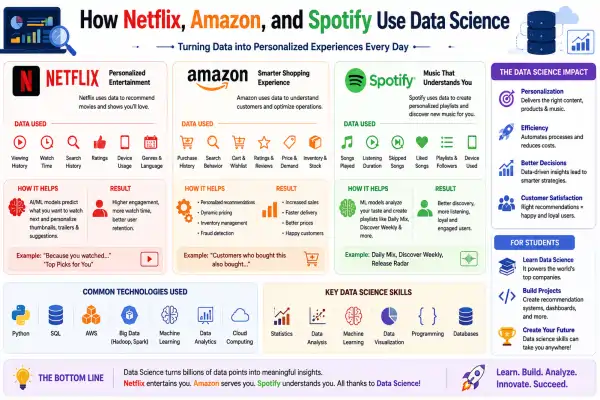
To achieve this, Netflix analyses information such as:
- Viewing history
- Watch time
- Search history
- User ratings
- Preferred genres
- Language preferences
- Viewing habits across different devices
Machine Learning algorithms use this information to predict what each user is most likely to watch next.
For example, someone who regularly watches science fiction films, technology documentaries, and AI-related programmes will receive recommendations featuring similar content through sections such as “Because You Watched…” and “Recommended for You.”
As viewing habits change, the recommendations continue to improve.
Amazon: Creating Smarter Shopping Experiences
Amazon uses Data Science across almost every aspect of its business.
The platform analyses customers’ purchase history, browsing behaviour, wish lists, shopping baskets, product reviews, and search activity to recommend products that match individual interests.
Data Science also supports dynamic pricing, allowing Amazon to adjust prices according to demand, competition, seasonal trends, and product availability.
Behind the scenes, predictive analytics helps the company forecast customer demand, manage inventory efficiently, and reduce delivery times.
Machine Learning also plays a crucial role in fraud detection by identifying suspicious transactions and helping protect customers from fraudulent activities.
Spotify: Understanding Musical Preferences
Spotify’s recommendation system is another excellent example of Data Science in action.
The platform analyses information including:
- Songs played
- Listening duration
- Skipped tracks
- Favourite artists
- Playlists
- Time of listening
- Devices used
Using these insights, Spotify creates personalised playlists such as Daily Mix, Discover Weekly, and Release Radar.
For example, if a listener frequently enjoys lo-fi music, instrumental tracks, or classical piano, Spotify recommends similar artists and introduces new music that closely matches those preferences.
This continuous learning process keeps users engaged while helping them discover fresh content.
The Technology Behind Intelligent Recommendations
Although Netflix, Amazon, and Spotify operate in different industries, they rely on many of the same technologies.
These include:
- Machine Learning
- Artificial Intelligence
- Big Data Analytics
- Predictive Analytics
- Recommendation Systems
- Cloud Computing
Together, these technologies analyse millions of interactions, identify behavioural patterns, and generate highly personalised recommendations within seconds.
Skills That Power Recommendation Systems
Behind every intelligent recommendation engine is a team of skilled Data Science professionals.
Students interested in this field should focus on developing expertise in:
- Python programming
- SQL
- Statistics
- Machine Learning
- Data Visualisation
- Cloud Computing
- Deep Learning
- Big Data technologies
- Artificial Intelligence
Equally important are analytical thinking, problem-solving, and the ability to interpret data effectively.
How Students Can Begin Their Data Science Journey
Building a career in Data Science starts with strong fundamentals.
Students should first learn programming languages such as Python and SQL before developing a solid understanding of Statistics, Probability, and Linear Algebra.
The next step is to gain experience with data analysis tools such as Pandas, NumPy, and Matplotlib, followed by Machine Learning libraries including Scikit-learn, TensorFlow, and PyTorch.
Practical experience is equally valuable. Projects such as a movie recommendation system, product recommendation engine, music recommendation platform, customer segmentation model, sales prediction application, or sentiment analysis tool help students apply theoretical concepts to real-world problems while building an impressive portfolio.
Career Opportunities in Data Science
As organisations increasingly rely on data-driven decision-making, demand for Data Science professionals continues to grow.
Popular career opportunities include:
- Data Scientist
- Machine Learning Engineer
- Data Analyst
- AI Engineer
- Business Intelligence Analyst
- Data Engineer
- Recommendation Systems Engineer
- Big Data Developer
These roles offer exciting opportunities to work on innovative technologies that influence millions of users every day.
The Future of Data Science
Advances in Generative AI, AI Agents, Explainable AI (XAI), Real-Time Analytics, Edge AI, and Hyper-Personalisation will make digital platforms even more intelligent in the years ahead.
Businesses will continue using Data Science to provide faster services, improve customer satisfaction, and deliver increasingly personalised digital experiences.
Conclusion
Netflix, Amazon, and Spotify demonstrate how Data Science has transformed entertainment, online shopping, and music streaming by understanding user behaviour and delivering highly personalised experiences.
For students pursuing careers in Data Science, Artificial Intelligence, or Information Technology, these platforms provide valuable examples of how programming, analytics, and Machine Learning solve real-world problems.
By developing strong technical skills, building practical projects, and embracing continuous learning, today’s students can contribute to creating the next generation of intelligent digital platforms.
“Data is the new fuel, but Data Science is the engine that transforms information into innovation.”
Whether your ambition is to develop smarter recommendation systems, improve online services, or create entirely new digital experiences, your journey begins with learning Data Science today.