
 Author: Department of Fire & Safety Engineering
Fire is one of the most destructive emergencies that can occur in homes, workplaces, industries, and public buildings. While a small fire may often be brought under control quickly, the situation becomes far more dangerous when it spreads beyond its point of origin. Such incidents are known as breakout fires and can rapidly endanger lives, destroy property, and disrupt essential services.
Controlling a breakout fire requires prompt action, appropriate firefighting techniques, and effective teamwork. Understanding these methods is essential not only for firefighters but also for students of Fire and Safety Engineering, who will play a crucial role in protecting lives and property in the future.
What Is a Breakout Fire?
A breakout fire is a fire that escapes from its original location and spreads to adjacent rooms, floors, buildings, or open spaces. It can travel through doors, windows, ceilings, ventilation ducts, service shafts, or other structural openings. If the fire is not contained quickly, it becomes increasingly difficult to control and may develop into a major emergency.
Breakout fires can occur in a wide range of locations, including:
- Residential buildings
- Educational institutions
- Factories and industrial facilities
- Warehouses
- Shopping centres
- Forests and grasslands
Understanding how fires spread is the first step towards controlling them effectively.
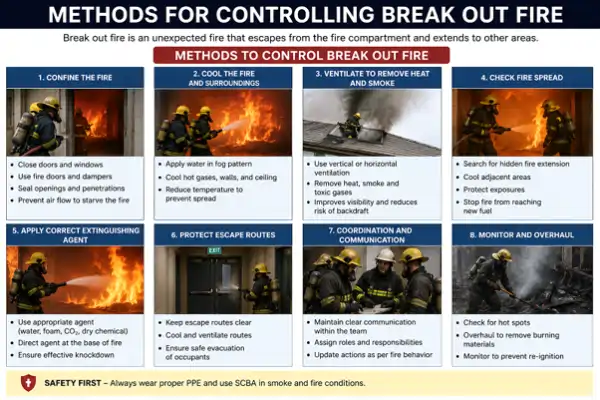
- Contain the Fire
The primary objective during a breakout fire is to prevent further spread.
Firefighters achieve this by closing doors and windows, using fire-rated doors where available, sealing openings through which smoke or flames may travel, and restricting the supply of fresh oxygen that fuels combustion.
This process, known as fire containment, slows the spread of flames, protects unaffected areas, and provides occupants with valuable time to evacuate safely.
- Cool the Fire
Heat is one of the three essential components of the fire triangle. Reducing the temperature is therefore one of the most effective methods of controlling a fire.
Water remains the most widely used extinguishing medium for ordinary combustible materials. Firefighters not only cool the burning material but also spray nearby walls, roofs, and structural elements to prevent the fire from spreading to adjacent areas.
Cooling helps to:
- Reduce the fire’s temperature.
- Protect surrounding structures and materials.
- Minimise the risk of fire extension and structural damage.
- Control Smoke and Heat
Smoke is responsible for many fire-related injuries and fatalities because it reduces visibility and contains toxic gases.
Proper ventilation removes smoke and accumulated heat from the affected area, allowing firefighters to work more safely and improving visibility during rescue operations.
Effective smoke control also reduces the likelihood of dangerous events such as flashover or backdraught, which can occur when heat and combustible gases accumulate within an enclosed space.
- Detect Hidden Fires
Even after visible flames have been extinguished, fire may continue to smoulder inside walls, ceilings, roof spaces, or electrical ducts.
Firefighters carefully inspect these concealed areas to identify hidden hotspots that could reignite later. Modern firefighting teams often use thermal imaging cameras to detect heat trapped behind walls and within structural components.
Identifying and extinguishing hidden fires is essential for preventing secondary outbreaks.
- Use the Correct Fire Extinguisher
Different classes of fire require different extinguishing agents. Using the wrong extinguisher may be ineffective or even make the situation more dangerous.
Common extinguishing media include:
- Water for fires involving wood, paper, and cloth.
- Foam for flammable liquids such as petrol and diesel.
- Carbon dioxide (CO₂) for electrical equipment and sensitive electronics.
- Dry chemical powder for multiple classes of fire, including combustible solids, liquids, gases, and electrical equipment.
Selecting the appropriate extinguishing agent improves firefighting efficiency while ensuring the safety of both responders and occupants.
- Maintain Safe Evacuation Routes
Protecting human life is always the highest priority during any fire emergency.
Firefighters ensure that escape routes remain free from smoke, flames, and other hazards. They guide occupants towards designated assembly points while giving special assistance to children, older adults, and people with injuries or disabilities.
Well-planned evacuation procedures significantly reduce the risk of casualties during a breakout fire.
- Communicate and Work as a Team
Firefighting is a coordinated team effort that depends on effective communication and disciplined operations.
Fire crews maintain constant contact through radio communication, follow the instructions of incident commanders, share information about changing fire conditions, and support one another throughout rescue and suppression activities.
Good teamwork enables firefighters to respond more efficiently while reducing operational risks.
- Conduct a Thorough Post-Fire Inspection
Extinguishing visible flames does not necessarily mean the emergency has ended.
Before leaving the site, firefighters conduct a detailed inspection to identify hotspots, remove smouldering debris, cool affected areas, and ensure that the fire cannot reignite.
This final assessment is a vital part of firefighting operations, as undetected hotspots can lead to another outbreak hours after the initial incident.
Essential Firefighter Safety Equipment
Firefighters work in extremely hazardous environments and rely on specialised personal protective equipment (PPE) to safeguard themselves.
Essential equipment includes:
- Fire-resistant protective clothing
- Helmet with face protection
- Heat-resistant gloves
- Safety boots
- Self-Contained Breathing Apparatus (SCBA)
This equipment protects firefighters from intense heat, falling debris, smoke, and toxic gases while enabling them to operate safely during emergency response.
The Importance of Fire Prevention
Although effective firefighting techniques are essential, preventing fires remains the most effective way to protect lives and property.
Simple preventive measures include:
- Inspecting electrical wiring regularly.
- Installing smoke detectors and fire alarm systems.
- Maintaining suitable fire extinguishers.
- Storing flammable materials safely.
- Conducting regular fire drills.
- Providing fire safety training for employees, students, and family members.
Developing a strong culture of fire safety significantly reduces the likelihood of breakout fires and improves emergency preparedness.
Conclusion
Breakout fires present serious challenges because they spread rapidly and threaten both lives and infrastructure. Successfully controlling them requires a combination of fire containment, cooling techniques, smoke management, appropriate extinguishing agents, safe evacuation procedures, and effective teamwork.
Equally important is thorough post-fire inspection to eliminate hidden hotspots and prevent reignition. Alongside these response measures, fire prevention through proper planning, regular inspections, and public awareness remains the most effective defence against devastating fire incidents.
For students of Fire and Safety Engineering, understanding these principles provides the foundation for developing the technical knowledge and practical skills needed to protect communities and contribute to safer buildings, industries, and public spaces. As future fire safety professionals, their expertise will play a vital role in reducing fire risks and ensuring a safer society.