 Author: Department of Computer Science & Engineering
Cloud computing has become one of the most important technologies driving today’s digital world. Every time you stream a movie on Netflix, store photographs on Google Drive, shop on Amazon, or use online banking, cloud computing works behind the scenes to deliver these services quickly, securely, and reliably. As organisations continue migrating their applications and data to the cloud, the demand for professionals with cloud computing skills is growing rapidly.
For Computer Science and Engineering (CSE) students, understanding cloud platforms is no longer an optional skill—it has become an important foundation for a successful career in the IT industry. Employers today seek software developers who not only write efficient code but also understand how applications are deployed, managed, and scaled using cloud technologies. Among the many cloud service providers available, Amazon Web Services (AWS) and Microsoft Azure are the two most widely adopted platforms and offer excellent opportunities for students to build industry-relevant skills.
What is Cloud Computing?
Cloud computing refers to the delivery of computing resources such as servers, storage, databases, networking, and software over the internet instead of relying solely on local computers or physical infrastructure.
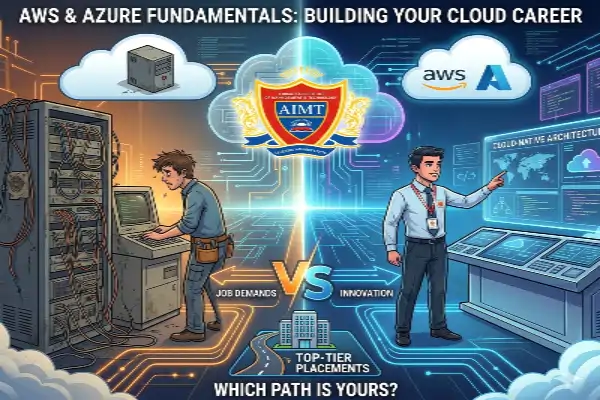
In the past, organisations needed expensive hardware and dedicated server rooms to run applications. Today, businesses can access computing resources on demand from cloud providers, paying only for what they use. This approach reduces infrastructure costs, improves flexibility, and allows applications to scale quickly as user demand changes.
For software developers, cloud computing simplifies application deployment and management while enabling collaboration across teams located anywhere in the world.
AWS or Azure: Which Platform Should You Choose?
Both AWS and Microsoft Azure are industry-leading cloud platforms, and either provides an excellent starting point for students.
Amazon Web Services (AWS) is currently the world’s largest cloud platform and is widely used by technology companies, start-ups, and global enterprises. It offers an extensive range of cloud services along with a generous Free Tier that allows students to gain practical experience. Beginners often start with the AWS Certified Cloud Practitioner certification to understand cloud fundamentals.
Microsoft Azure has become the preferred cloud platform for many enterprises, government organisations, and businesses already using Microsoft technologies. Students can access Azure for Students, which provides free cloud credits without requiring a credit card. The recommended entry-level certification is Microsoft Certified: Azure Fundamentals (AZ-900).
Rather than debating which platform is superior, students should select the one that best aligns with their career goals. Those interested in product-based companies, software development, and start-ups may find AWS particularly valuable, while students aiming for enterprise IT, cloud administration, or Microsoft-based environments may benefit more from Azure. Once the fundamentals are mastered, learning a second cloud platform becomes much easier.
Why Learn Cloud Computing During College?
Developing cloud computing skills before graduation offers several significant advantages.
First, cloud knowledge has become a common requirement in software engineering, DevOps, cybersecurity, artificial intelligence, and data engineering roles. Many employers now expect graduates to possess at least a basic understanding of cloud services.
Second, entry-level certifications from AWS or Microsoft strengthen a student’s résumé and demonstrate initiative beyond the university curriculum. Such certifications often help candidates stand out during internships and campus placements.
Cloud computing also enables students to deploy their own applications instead of simply submitting source code. Demonstrating a live website, web application, or API hosted on the cloud creates a stronger impression during technical interviews and showcases practical implementation skills.
Perhaps most importantly, cloud computing complements almost every modern technology. Whether students pursue artificial intelligence, machine learning, cybersecurity, mobile application development, web development, or data analytics, cloud platforms provide the infrastructure needed to build, deploy, and manage these solutions efficiently.
How to Get Started
Beginning your cloud computing journey is easier than ever.
Students can create a free AWS Free Tier account or register for Azure for Students using their institutional email address. Both platforms provide sufficient free resources for beginners to complete practical exercises and small projects.
Official learning platforms such as AWS Skill Builder and Microsoft Learn offer structured beginner courses, interactive laboratories, and guided tutorials. Completing these learning paths provides a strong understanding of core cloud concepts.
Once familiar with the basics, students should deploy a simple project such as a personal portfolio website, blog, or web application. Even a small cloud-hosted project demonstrates practical knowledge far more effectively than theoretical learning alone.
Students may then prepare for an entry-level certification such as AWS Certified Cloud Practitioner or Microsoft Azure Fundamentals, which can typically be completed within a few weeks of consistent study.
Conclusion
Cloud computing is no longer a future technology—it is the foundation of today’s digital economy. Organisations across every industry increasingly depend on cloud platforms to deliver secure, scalable, and reliable services. As a result, cloud skills have become an important asset for aspiring software professionals.
For CSE students, learning AWS or Azure during college provides a valuable competitive advantage by strengthening technical knowledge, improving employability, and creating opportunities for practical project development. With free learning resources, cloud credits, and industry-recognised certifications readily available, there has never been a better time to begin. The cloud is already transforming the technology landscape, and students who invest in these skills today will be better prepared for tomorrow’s careers.