
 Author: Department of Mechanical Engineering
Wind energy is one of the fastest-growing renewable energy sources worldwide and plays a vital role in meeting rising electricity demands while reducing carbon emissions. Choosing the right wind turbine design is an important engineering decision, as the two principal configurations—Horizontal Axis Wind Turbines (HAWTs) and Vertical Axis Wind Turbines (VAWTs)—differ in efficiency, construction, maintenance requirements, and applications. The most suitable option depends on wind conditions, available space, installation constraints, and project objectives.
Understanding Horizontal Axis Wind Turbines
Horizontal Axis Wind Turbines (HAWTs) are the most widely used wind turbines and dominate utility-scale wind farms worldwide. Their rotor rotates about a horizontal shaft that remains parallel to both the ground and the wind direction. The familiar three-bladed rotor uses airfoil-shaped blades that generate aerodynamic lift in much the same way as an aircraft wing.
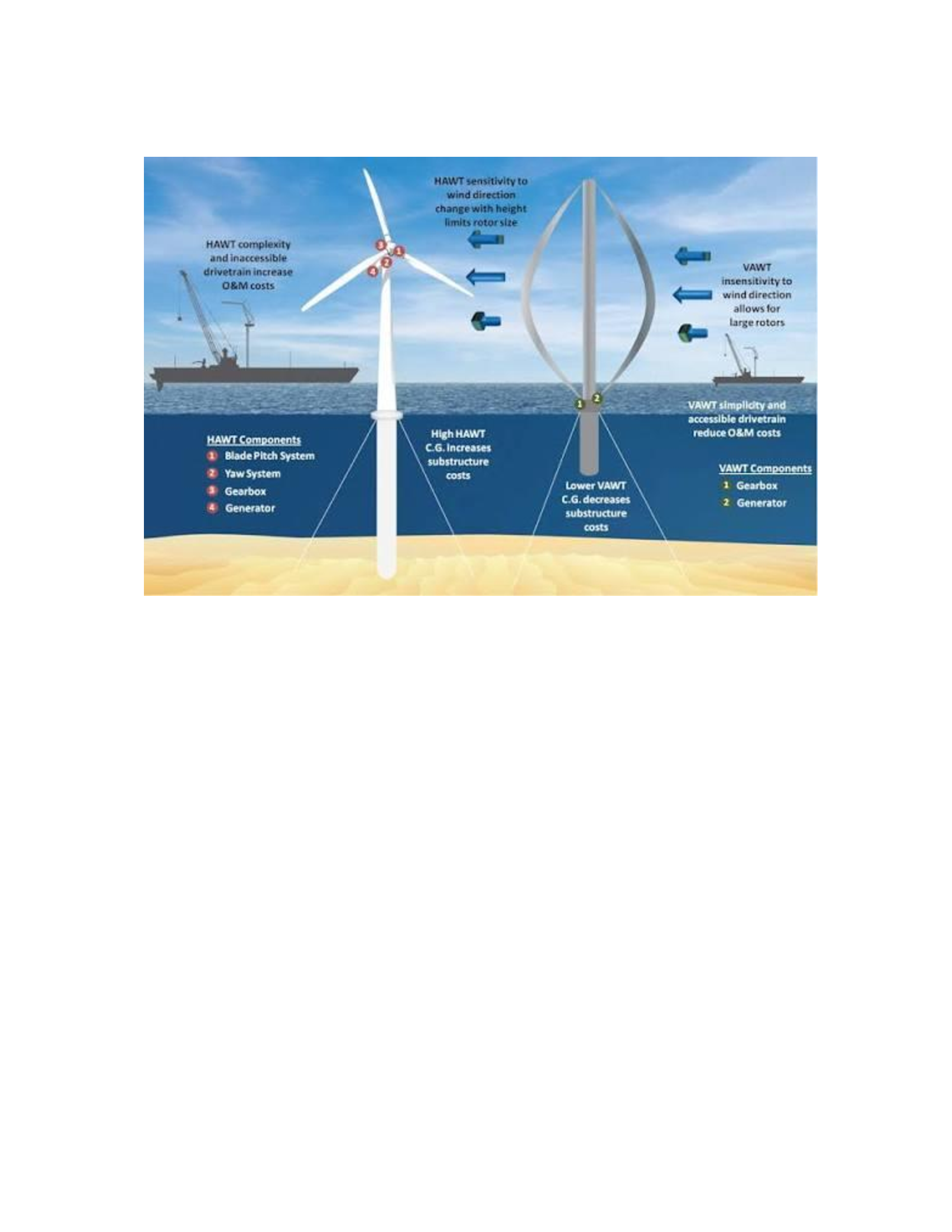
HAWTs typically achieve a power coefficient (Cp) of 0.40–0.50, allowing them to extract more wind energy than most vertical-axis designs. Their higher efficiency and lower cost per kilowatt-hour make them the preferred choice for commercial and offshore wind farms. However, they must remain aligned with the wind using yaw mechanisms and wind sensors, increasing mechanical complexity and maintenance requirements.
Understanding Vertical Axis Wind Turbines
Vertical Axis Wind Turbines (VAWTs) rotate around a vertical shaft that is perpendicular to the ground. Their key advantage is the ability to capture wind from any direction without requiring a yaw mechanism.
The two most common VAWT designs are Darrieus and Savonius turbines. Darrieus turbines use curved airfoil-shaped blades to generate lift and typically achieve a power coefficient of 0.30–0.42. Savonius turbines use scoop-shaped blades that rely on aerodynamic drag. Although less efficient, with Cp values of 0.15–0.30, they start more easily in low wind speeds and have a simpler mechanical design.
Because they accept wind from all directions, VAWTs perform well in turbulent conditions commonly found around buildings and rooftops, making them suitable for residential, urban, and off-grid applications.
Comparison of Horizontal Axis Wind Turbines (HAWTs) and Vertical Axis Wind Turbines (VAWTs)
| Factor | Horizontal Axis Wind Turbine (HAWT) | Vertical Axis Wind Turbine (VAWT) |
| Operating Principle | Rotor rotates about a horizontal shaft parallel to the wind direction | Rotor rotates about a vertical shaft, accepting wind from any direction |
| Typical Power Coefficient (Cp) | 0.40–0.50 | 0.30–0.42 (Darrieus); 0.15–0.30 (Savonius) |
| Yaw Mechanism Required | Yes | No |
| Wind Direction Sensitivity | High – must remain aligned with the wind | Very low – operates effectively regardless of wind direction |
| Suitable Wind Conditions | Steady, moderate to high wind speeds | Turbulent, gusty, and variable wind conditions |
| Typical Installation Height | Tall towers (30–90+ m for utility-scale projects) | Low to moderate installation height |
| Typical Cut-in Wind Speed | Generally higher | Generally lower |
| Self-starting Capability | Moderate; may require pitch or start assistance | Savonius: Excellent; Darrieus: Limited without external assistance |
| Maintenance Accessibility | Generator and gearbox located in the nacelle, requiring elevated maintenance | Generator often located near ground level, simplifying maintenance |
| Operational Noise | Moderate to high due to greater blade tip speeds | Generally lower |
| Installation Footprint | Requires greater spacing between turbines | Compact footprint suitable for space-constrained sites |
| Typical Applications | Utility-scale wind farms, commercial installations, offshore projects | Rooftop systems, residential installations, urban environments, and off-grid applications |
| Relative Cost at Scale | Lower cost per installed kW for large-scale projects | Generally higher cost per installed kW for small-scale installations |
Advantages and Limitations of HAWTs and VAWTs
Both turbine designs have distinct strengths and limitations.
Horizontal Axis Wind Turbines (HAWTs) offer high aerodynamic efficiency, proven reliability, and lower cost per kilowatt-hour, making them ideal for utility-scale and offshore projects. However, they require yaw mechanisms, taller towers, higher installation costs, and more challenging maintenance.
Vertical Axis Wind Turbines (VAWTs) operate without a yaw mechanism and perform well in turbulent wind conditions. Their lower installation height simplifies maintenance, making them suitable for rooftops, urban environments, and off-grid systems. However, they generally have lower aerodynamic efficiency and capacity factors, while Darrieus designs experience greater cyclic fatigue loading, limiting their large-scale commercial use.
Selecting the Appropriate Turbine
The choice of turbine should be based on site conditions and project requirements rather than efficiency alone.
HAWTs are best suited to utility-scale projects where steady, high-speed winds allow maximum energy generation. VAWTs are more appropriate for urban environments, rooftops, and hybrid renewable energy systems where wind direction is variable and easier maintenance is desirable. For rooftop installations, a structural assessment should always be carried out to evaluate vibration and loading effects.
Conclusion
There is no universal winner between Horizontal Axis Wind Turbines (HAWTs) and Vertical Axis Wind Turbines (VAWTs). HAWTs remain the preferred choice for large-scale electricity generation because of their superior efficiency and energy output, while VAWTs provide practical advantages in turbulent and space-constrained environments through simpler operation and easier maintenance.
Ultimately, engineers should select the turbine that best matches the site’s wind characteristics, available space, maintenance requirements, and long-term project objectives. Choosing the appropriate design ensures optimum performance, improved reliability, and more sustainable wind energy generation.