
 Author: Mr. Aditya Mishra
Introduction
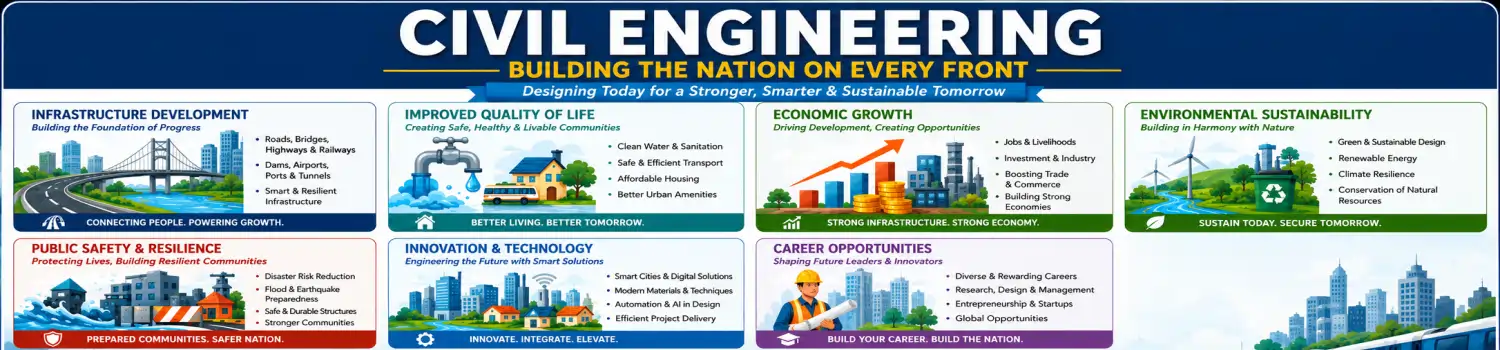
Civil Engineering is one of the oldest and most influential branches of engineering, yet it continues to evolve with the changing needs of society. Every road, bridge, building, airport, railway, and water supply system depends on the expertise of civil engineers. As India continues to invest in smart cities, expressways, metro rail, sustainable infrastructure, and urban development, the demand for skilled civil engineers remains strong.
For students who have completed Class 12 with Physics, Chemistry, and Mathematics (PCM), Civil Engineering offers an excellent career that combines scientific knowledge, creativity, technical expertise, and problem-solving. It is a profession that enables engineers to create infrastructure that benefits communities while contributing directly to national development.
Among the engineering institutions in Uttar Pradesh, Ambalika Institute of Management & Technology (AIMT), Lucknow offers an AKTU-affiliated B.Tech programme in Civil Engineering with an emphasis on practical learning, modern laboratories, and industry exposure.
Why Choose Civil Engineering After Class 12?
Civil Engineering focuses on the planning, design, construction, operation, and maintenance of the infrastructure that supports modern life. Civil engineers contribute to residential and commercial buildings, highways, bridges, metro systems, airports, dams, water supply networks, industrial facilities, and environmental protection projects.
Unlike many careers that are primarily office-based, Civil Engineering allows professionals to transform ideas into physical structures that serve society for generations. It offers opportunities to address real-world challenges while supporting sustainable development and improving quality of life.
Why Study Civil Engineering in Lucknow?
Lucknow has emerged as one of North India’s leading educational and infrastructure hubs. Ongoing development through expressways, metro expansion, residential projects, hospitals, educational institutions, and commercial complexes provides students with valuable exposure to modern engineering practices.
Studying in such an environment enables students to relate classroom learning to real infrastructure projects through industrial visits, practical training, and interaction with engineering professionals.
Eligibility and Programme Overview
Students who have completed Class 12 with Physics, Chemistry, and Mathematics (PCM) are generally eligible for admission to a B.Tech Civil Engineering programme, subject to university regulations. Diploma holders in Civil Engineering or other recognised engineering disciplines may also be eligible under applicable admission norms.
The four-year programme develops both theoretical knowledge and practical engineering skills through classroom learning, laboratory work, field training, and project-based activities.
What Students Learn
The curriculum covers the major areas of Civil Engineering, including Structural Engineering, Geotechnical Engineering, Transportation Engineering, Environmental Engineering, Surveying, Construction Technology, Water Resources Engineering, Project Management, and Estimation & Costing.
Students learn to analyse and design structures, investigate soil conditions, develop transportation systems, manage construction projects, and apply sustainable engineering practices. This broad foundation prepares graduates for diverse roles across the infrastructure sector.
The Importance of Practical Learning
Practical experience is an essential part of Civil Engineering education. Laboratory work, surveying exercises, industrial visits, internships, and exposure to construction projects help students develop technical competence and confidence.
According to AIMT, the department offers specialised laboratories for Solid Mechanics, Material Testing, Structural Analysis, Geotechnical Engineering, Hydraulics, Environmental Engineering, Fluid Flow, and Geo-informatics. Students also benefit from industry interaction and practical exposure through Ambalika Construction.
Why Choose Ambalika Institute of Management & Technology (AIMT)?
Choosing the right engineering college plays an important role in shaping a student’s career. AIMT offers B.Tech programmes affiliated with Dr A.P.J. Abdul Kalam Technical University (AKTU) and approved by AICTE, following the prescribed curriculum while emphasising practical and industry-oriented learning.
The Civil Engineering department is supported by experienced faculty, modern laboratories, technical workshops, industrial visits, and project-based learning. The institute’s Centre of Excellence further helps students strengthen industry-relevant skills through technical training and practical exposure.
Career Opportunities
Civil Engineering graduates have opportunities across both government and private sectors. Career options include Structural Engineer, Site Engineer, Construction Engineer, Highway Engineer, Environmental Engineer, Geotechnical Engineer, Project Engineer, Design Engineer, Quantity Surveyor, Planning Engineer, and Quality Control Engineer.
Graduates may also pursue higher studies, research, or competitive examinations such as GATE to expand their career prospects.
Future Scope
India’s continued investment in transportation networks, smart cities, housing, renewable energy, water management, and sustainable infrastructure ensures strong long-term demand for Civil Engineering professionals.
Emerging technologies such as Building Information Modelling (BIM), Geographic Information Systems (GIS), drone surveying, digital construction management, and artificial intelligence are transforming the profession. Civil engineers who combine strong technical foundations with modern digital skills will be well prepared for future industry requirements.
Conclusion
Civil Engineering is much more than the construction of buildings and roads. It is a profession that shapes cities, strengthens economies, and improves everyday life. For students interested in mathematics, science, design, and solving practical challenges, it offers a rewarding and future-oriented career.
For students planning to pursue B.Tech Civil Engineering after Class 12 in Lucknow, Ambalika Institute of Management & Technology (AIMT) provides an AKTU-affiliated programme supported by experienced faculty, well-equipped laboratories, practical learning opportunities, and industry engagement. With dedication, technical expertise, and continuous learning, graduates can build successful careers while contributing to India’s rapidly growing infrastructure sector.