 Introduction
Traditional cybersecurity relied on a simple assumption: once a user entered the organisational network, they could generally be trusted. This approach worked reasonably well when employees worked primarily from office locations and business applications were hosted within secure corporate networks.
Today, however, organisations operate in a very different environment. Employees work remotely, business applications run in the cloud, and cybercriminals routinely exploit stolen credentials rather than attempting to breach network perimeters. As a result, the traditional security model is no longer sufficient.
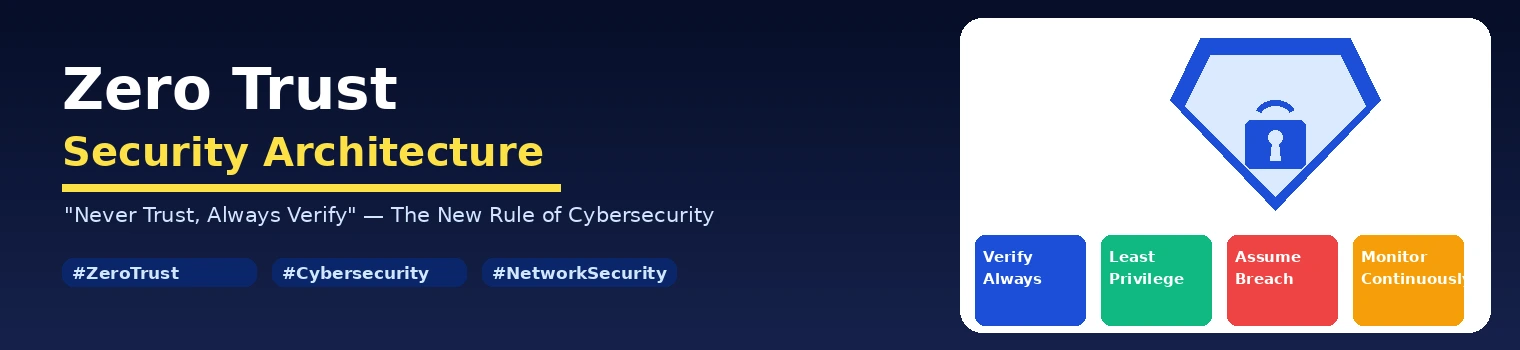
Zero Trust Security Architecture addresses this challenge through one fundamental principle: Never Trust, Always Verify. Every user, device, application, and access request must be authenticated, authorised, and continuously validated before access is granted, regardless of whether the request originates inside or outside the organisational network.
Figure 1: Zero Trust Security Architecture follows the principle of “Never Trust, Always Verify” to protect users, devices, and organisational resources.
Why the Traditional Security Model No Longer Works
Conventional cybersecurity followed the “castle-and-moat” approach. Once users successfully passed the network perimeter, they were generally trusted to access internal resources with minimal additional verification.
Several developments have made this model increasingly ineffective:
- Remote and hybrid work: Employees now access corporate resources from homes, airports, cafés, and other remote locations, making the concept of a secure internal network increasingly obsolete.
- Cloud adoption: Business applications and data are hosted across cloud platforms such as AWS, Microsoft Azure, Google Cloud, and numerous Software-as-a-Service (SaaS) solutions, reducing the importance of traditional network boundaries.
- Credential theft and insider threats: Many major cyberattacks now occur through compromised credentials obtained via phishing attacks, malware, or dark web marketplaces rather than direct network intrusion.
Figure 2: Comparison between the traditional castle-and-moat security model and the Zero Trust approach based on continuous verification and least-privilege access.
What Zero Trust Means in Practice
Zero Trust is not a single product but a cybersecurity framework that governs how access decisions are made.
Before granting access, organisations continuously verify:
- The user’s identity.
- The security status of the device being used.
- Whether the requested resource is appropriate for that user.
- The location, timing, and behavioural context of the access request.
Access is granted only to the specific resource requested and only for the required duration. Verification continues throughout the session rather than ending after login.
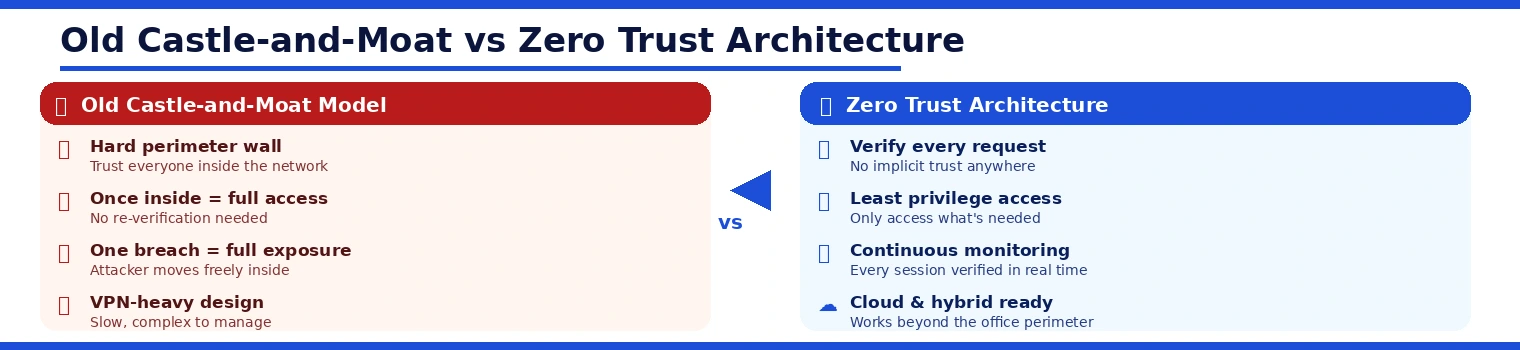
Figure 3: The five foundational principles that enable an effective Zero Trust Security Architecture.
The Five Pillars of Zero Trust
Identity Verification
Every user must verify their identity through strong authentication mechanisms, typically including Multi-Factor Authentication (MFA). Passwords alone are no longer considered sufficient.
Device Health Checks
Only trusted and compliant devices meeting organisational security standards—such as current software updates, encryption, and endpoint protection—are permitted to access corporate resources.
Least Privilege Access
Users receive only the minimum permissions required to perform their responsibilities, significantly reducing the impact of compromised accounts.
Continuous Monitoring
Security monitoring continues throughout every user session. Suspicious behaviour, such as unusual login locations or abnormal data transfers, can trigger additional authentication or automatic session termination.
Micro-Segmentation
Networks are divided into smaller security zones that restrict lateral movement. Even if attackers compromise one area, they cannot easily access the remainder of the network.
Real-World Deployments
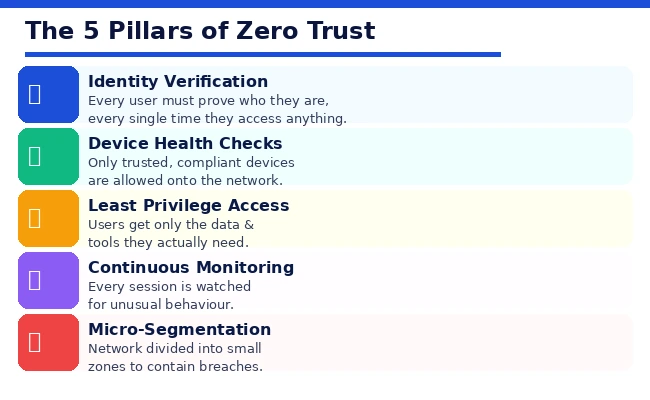
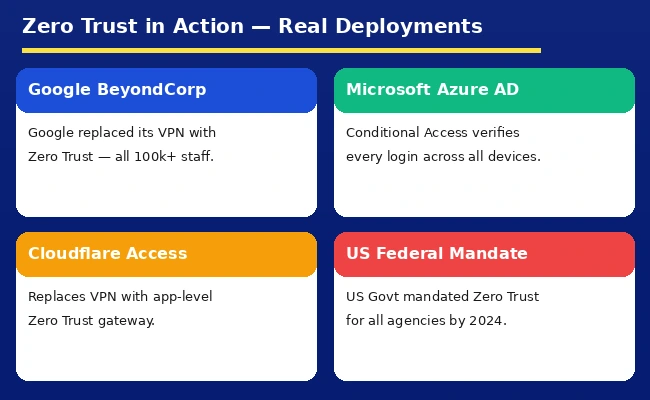
Figure 4: Examples of organisations and government initiatives implementing Zero Trust Security Architecture at enterprise scale.
Google BeyondCorp: Following a major cyberattack, Google replaced traditional VPN-based security with its BeyondCorp Zero Trust model, enabling secure access for employees regardless of location.
Microsoft Azure Active Directory: Microsoft’s Conditional Access capabilities continuously evaluate identity, device compliance, location, and behavioural signals before granting access to enterprise resources.
Cloudflare Access: Cloudflare provides application-level Zero Trust access, allowing employees to securely connect only to authorised applications instead of entire corporate networks.
United States Federal Government: Executive mandates have accelerated Zero Trust adoption across federal agencies, reinforcing its position as a modern cybersecurity standard.
Emerging Trends
Zero Trust continues to evolve alongside advances in cybersecurity.
Artificial intelligence increasingly supports behavioural analytics by identifying unusual activity in real time. Passwordless authentication using biometrics, hardware security keys, and cryptographic credentials is reducing dependence on traditional passwords. Organisations are also extending Zero Trust principles to Internet of Things (IoT) devices and operational technology environments, while Secure Access Service Edge (SASE) integrates Zero Trust Network Access with cloud-based security services to simplify large-scale deployment.
Future Scope
Zero Trust has rapidly evolved from an emerging security concept into a foundational cybersecurity strategy. As organisations continue adopting cloud computing, hybrid work, and digital transformation, continuous verification will increasingly become the standard method for protecting users, applications, and sensitive information.
Future implementations are expected to integrate Zero Trust directly into software applications, APIs, and cloud-native architectures, embedding security throughout the technology stack rather than relying solely on network boundaries.
Closing Remarks
Cybersecurity can no longer depend on the assumption that users or devices should be trusted simply because they are inside an organisational network. Zero Trust replaces this outdated approach with continuous verification, least-privilege access, and ongoing monitoring.
By assuming that every access request requires validation, organisations can significantly reduce cyber risks, contain breaches more effectively, and build resilient digital infrastructures capable of supporting today’s increasingly connected world.