
 Author: Department of Mechanical Engineering
Figure 1. Battery Thermal Management System (BTMS) in an electric vehicle, illustrating coolant circulation, heat dissipation, and temperature control of the high-voltage battery pack and power electronics to improve battery performance, safety, and lifespan.
(Place immediately after the section “Thermal Management in Electric Vehicles”.)
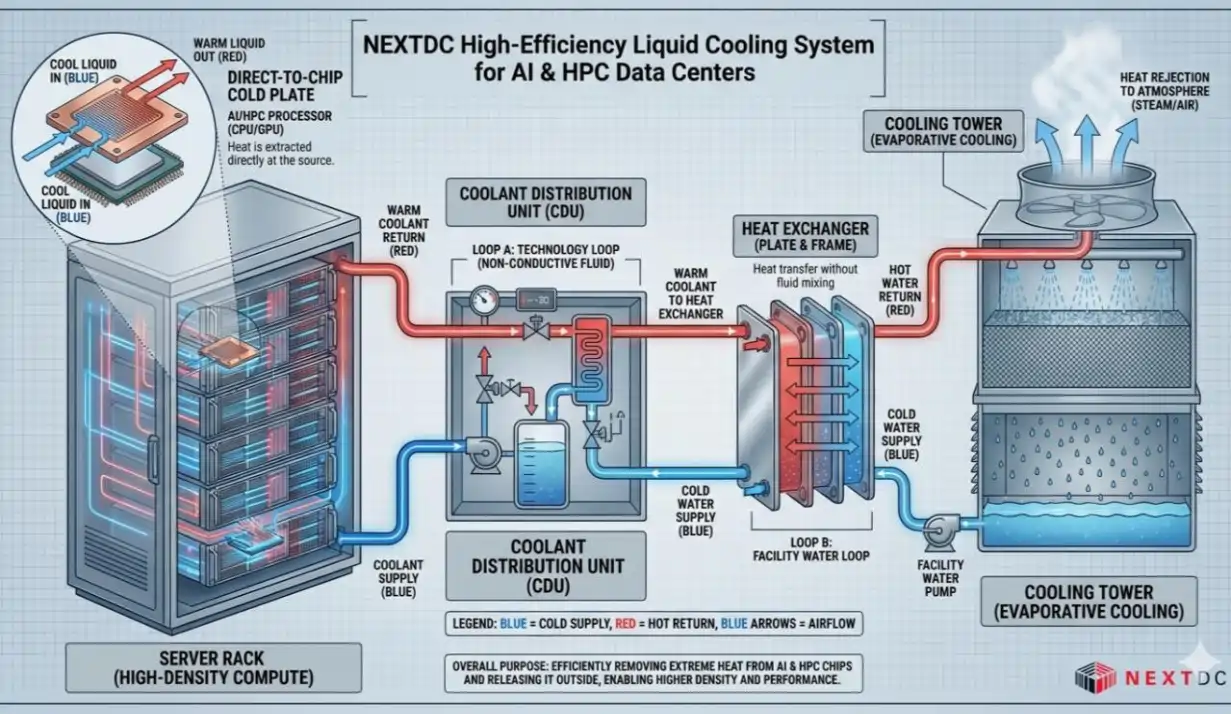 Figure 2. Direct-to-chip liquid cooling system for a high-density AI data centre, showing coolant distribution units (CDUs), heat exchangers, and cooling towers used to remove heat efficiently from high-performance server racks.
(Place immediately after the section “Data Centres: Cooling the Digital World”.)
As modern technologies become faster, smaller, and more powerful, managing heat has become one of the biggest engineering challenges. Whether it is an electric vehicle (EV), a high-performance computer, a data centre, or a spacecraft, effective thermal management is essential for ensuring safety, efficiency, reliability, and a long service life. Without proper cooling, excessive heat can reduce performance, damage components, and even create safety risks.
Next-generation thermal management focuses on innovative cooling technologies that outperform conventional air cooling while reducing energy consumption and environmental impact. These advanced systems are helping industries build more reliable, energy-efficient, and sustainable technologies capable of meeting the growing demands of the future.
Why Thermal Management Matters
Every electronic device and mechanical system generates heat during operation. If this heat is not dissipated effectively, it can lead to:
- Reduced efficiency
- Component failure
- Lower battery life
- Safety hazards
- Increased maintenance costs
Efficient thermal management ensures that equipment operates within its optimum temperature range, improving both performance and reliability. It also enhances energy efficiency, reduces downtime, and extends the lifespan of valuable components, making it an essential aspect of modern engineering design.
Emerging Thermal Management Technologies
- Liquid Cooling Systems
Unlike traditional air cooling, liquid cooling removes heat much more efficiently because liquids have a higher heat transfer capacity than air. Coolants circulate through channels near heat-generating components and transfer heat to radiators or heat exchangers, maintaining stable operating temperatures even under heavy workloads.
Applications
- Data centres
- Electric vehicles
- High-performance computers
- Industrial machinery
- Phase Change Materials (PCM)
Phase Change Materials absorb large amounts of heat while changing phase (solid to liquid), helping maintain stable temperatures without continuous power consumption. This passive cooling technique is particularly useful in systems where maintaining a consistent temperature is critical.
Applications
- Electric vehicle batteries
- Medical devices
- Solar energy systems
- Portable electronics
- Microchannel Heat Sinks
Microchannel heat sinks contain tiny channels that greatly increase heat transfer by maximising the contact area between the coolant and heated surfaces. Their compact design makes them especially suitable for modern electronic devices where space is limited.
Benefits
- Excellent heat dissipation
- Lightweight construction
- Suitable for compact electronic devices
- High cooling efficiency for advanced processors
- Heat Pipes and Vapour Chambers
Heat pipes transfer heat rapidly using evaporation and condensation inside sealed tubes. Vapour chambers work on a similar principle but distribute heat more evenly over larger surfaces, making them ideal for compact devices with high thermal loads.
Common Applications
- Laptops
- Smartphones
- Aerospace equipment
- LED lighting systems
- AI-Based Smart Thermal Management
Artificial Intelligence continuously monitors temperature sensors and predicts cooling requirements by analysing operating conditions in real time. This enables cooling systems to respond more efficiently while reducing unnecessary energy consumption.
AI enables:
- Intelligent fan speed control
- Predictive maintenance
- Energy optimisation
- Real-time thermal monitoring
These smart systems not only improve performance but also help reduce operating costs and minimise energy waste.
Thermal Management in Electric Vehicles
Electric vehicles rely heavily on efficient battery cooling because battery performance is highly sensitive to temperature. Modern Battery Thermal Management Systems (BTMS) are designed to:
- Maintain battery temperature between 20°C and 40°C
- Improve charging speed
- Increase battery lifespan
- Enhance driving range
- Prevent thermal runaway
Cooling methods include:
- Air cooling
- Liquid cooling
- Refrigerant cooling
- Immersion cooling
As EV adoption continues to grow worldwide, advanced thermal management systems are becoming increasingly important for improving battery safety, vehicle reliability, and overall driving efficiency.
Data Centres: Cooling the Digital World
Modern AI servers and cloud computing facilities generate enormous amounts of heat due to their continuous processing demands. Without effective cooling, servers can overheat, resulting in reduced performance and increased energy consumption.
Next-generation data centres now use:
- Direct-to-chip liquid cooling
- Immersion cooling
- Rear-door heat exchangers
- AI-driven cooling optimisation
These technologies significantly reduce electricity usage while supporting powerful computing systems, making large-scale digital infrastructure more sustainable and cost-effective.
Future Trends
Researchers are exploring several advanced technologies that promise even greater cooling efficiency, including:
- Nanofluids for enhanced heat transfer
- Graphene-based thermal materials
- 3D-printed heat exchangers
- Self-healing cooling systems
- Digital twins for thermal optimisation
- AI-integrated cooling networks
These innovations are expected to transform electronics, transportation, aerospace, renewable energy, and smart manufacturing by enabling more efficient and environmentally friendly thermal management solutions.
Conclusion
As technology continues to advance, effective thermal management has become more important than ever. Innovative cooling solutions not only improve the performance and reliability of electronic and mechanical systems but also contribute to energy efficiency and environmental sustainability. From electric vehicles and high-performance computing to renewable energy and aerospace applications, next-generation thermal management will play a crucial role in supporting future technological progress. For aspiring mechanical engineers, understanding these emerging cooling technologies is essential for designing smarter, safer, and more sustainable engineering systems.