Department of Computer Applications
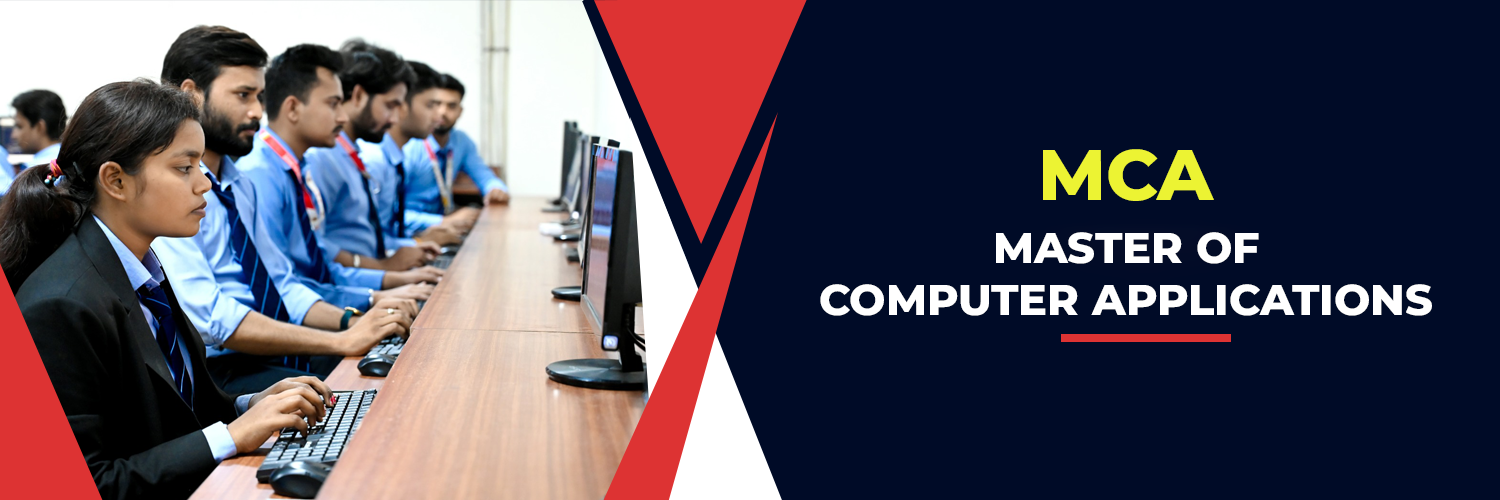
Ambalika Institute of Management and Technology is set to establish itself as a leading MCA college in Lucknow, offering a premier Master of Computer Applications (MCA) program. Affiliated with AKTU, the program is designed across four semesters to provide students with a strong foundation in computer applications, software development, emerging technologies, and industry-oriented skills. With a focus on academic excellence, practical learning, and career readiness, this MCA college in Lucknow aims to prepare aspiring IT professionals for successful careers in the rapidly evolving technology sector.
This dynamic program is designed to bridge the gap between advanced theoretical computing and the practical demands of the modern IT industry. MCA candidates will delve into the convergence of software engineering, data science, cloud architecture, and cybersecurity. By harnessing the power of high-level programming, algorithmic design, and distributed systems, our students will learn to engineer solutions that drive digital transformation across sectors such as finance, healthcare, e-commerce, and logistics. Core pillars—including intelligent system design, data security, network architecture, and scalable application development—will empower graduates to optimize everything from complex enterprise software and mobile ecosystems to AI-driven decision-making platforms.
As the digital landscape evolves, our graduates will be at the forefront of breakthroughs in Generative AI, cloud-native development, blockchain, and quantum computing. They will be prepared to tackle global challenges in cybersecurity, big data management, and digital infrastructure, influencing the technologies that define the future of the global economy.
Laboratories in the Department of Computer Applications
To ensure comprehensive technical proficiency, the department features state-of-the-art laboratory facilities:
-
- Programming & Algorithmic Design Lab: Dedicated to mastering advanced data structures and algorithm optimization.
- Artificial Intelligence & Machine Learning Lab: Equipped for developing neural networks, predictive models, and deep learning applications.
- Cloud Computing & DevOps Lab: Focused on containerization, server management, and deploying scalable cloud-native solutions.
- Cybersecurity & Network Lab: A secure environment for penetration testing, encryption research, and network vulnerability analysis.
- Database Management & Big Data Lab: Centered on high-volume data storage, NoSQL databases, and real-time data analytics.
- Software Engineering & Project Lab: A collaborative workspace for lifecycle management, version control, and capstone software development.
- Internet of Things (IoT) Lab: Dedicated to hardware-software integration, sensor data processing, and smart systems research.
- Graphics & Web Technologies Lab: Focused on UI/UX design, full-stack web development, and interactive multimedia application creation.
Program Educational Objectives (PEOs)
PEOs describe the career and professional accomplishments that graduates are expected to achieve within a few years after graduation.
PEO1: Graduates will establish successful careers in software development, IT services, data analytics, cloud computing, cybersecurity, entrepreneurship, and other emerging areas of computer applications in industry, academia, and government sectors.
PEO2: Graduates will demonstrate strong analytical, programming, and problem-solving abilities to design, develop, and manage efficient computing solutions for real-world challenges.
PEO3: Graduates will pursue lifelong learning through higher education, professional certifications, research, innovation, and adaptation to emerging technologies.
PEO4: Graduates will exhibit leadership, teamwork, communication skills, ethical values, and social responsibility to contribute effectively as professionals and responsible citizens.
Program Outcomes
POs describe what students are expected to know and be able to do by the time of graduation.
- PO1 (Foundation Knowledge): Apply knowledge of mathematics, programming logic and coding fundamentals for solution architecture and problem solving.
- PO2 (Problem Analysis): Identify, review, formulate and analyse problems for primarily focussing on customer requirements using critical thinking frameworks.
- PO3 (Development of Solutions): Design, develop and investigate problems with as an innovative approach for solutions incorporating ESG/SDG goals.
- PO4 (Modern Tool Usage): Select, adapt and apply modern computational tools such as development of algorithms with an understanding of the limitations including human biases.
- PO5 (Individual and Teamwork): Function and communicate effectively as an individual or a team leader in diverse and multidisciplinary groups. Use methodologies such as agile.
- PO6 (Project Management and Finance): Use the principles of project management such as scheduling, work breakdown structure and be conversant with the principles of Finance for profitable project management.
- PO7 (Ethics): Commit to professional ethics in managing software projects with financial aspects.Learn to use new technologies for cyber security and insulate customers from malware
- PO8 (Life-long learning): Change management skills and the ability to learn, keep up with contemporary technologies and ways of working.
Program Specific Outcomes
PSOs are specific to the MCA discipline and reflect the unique competencies gained by students in this program.
PSO1: Software Development and Deployment
Apply programming concepts, database management, software engineering principles, and modern frameworks to design, develop, test, and deploy scalable software applications for diverse business and societal needs.
PSO2: Emerging Technologies and Innovation
Analyze, design, and implement intelligent computing solutions using emerging technologies such as Artificial Intelligence, Machine Learning, Cloud Computing, Data Analytics, Cyber Security, and Internet of Things to solve real-world problems.
PSO3: Enterprise Computing and Research Orientation
Develop industry-oriented and research-driven solutions through system integration, project implementation, technical documentation, and innovation to address organizational and societal challenges effectively.
Department Vision
To develop competent and ethically responsible computer professionals with strong analytical, technical, and innovative skills, capable of addressing real-world challenges and contributing effectively to the advancement of industry and society.
Department Mission
M1: To provide quality education in computer applications through modern infrastructure, advanced laboratories, and an industry-oriented curriculum for academic excellence.
M2: To equip students with strong programming, problem-solving, research, and emerging technology skills to meet evolving industry requirements and entrepreneurial challenges.
M3: To encourage participation in co-curricular and extracurricular activities for developing leadership, teamwork, communication skills, and lifelong learning attitude.
M4: To inculcate professional ethics, social responsibility, integrity, and human values for creating responsible professionals and citizens.
Career Opportunities
The upcoming MCA program is engineered to open doors to high-impact roles in the global tech economy, including:
- Software Architect & Full-Stack Developer
- Cloud Computing Specialist & DevOps Engineer
- Data Scientist & Machine Learning Engineer
- Cybersecurity Architect & Network Consultant
- IT Project Manager & Technical Consultant
- Entrepreneurship in FinTech, EdTech, and SaaS
Industry Academia Interaction
We are building a robust framework to bridge the gap between academic theory and industry requirements through:
- Strategic Alliances: Establishing partnerships with global tech firms for joint research and curriculum input.
- Expert Engagement: Planning regular seminars and masterclasses featuring industry visionaries.
- Applied Learning: Designing pathways for students to participate in live industry projects and professional certification programs.
Department Achievements
- Anticipatory Research: The department is currently curating a research agenda focused on emerging fields like Generative AI, IoT, and Blockchain.
- Technical Readiness: Students and faculty are actively preparing to participate in national-level hackathons and technical competitions upon the program’s launch.
- Innovation Pipeline: A structured framework is being developed to support the creation and filing of intellectual property, including patents by our founding faculty and research teams.
Curriculum & Syllabus
Our MCA curriculum is designed with a future-proof perspective, covering:
- Core Fundamentals: Advanced Data Structures, Algorithms, and Distributed Operating Systems.
- Advanced Domains: Artificial Intelligence & Machine Learning, Big Data Analytics, Cloud Computing, and Modern Cybersecurity frameworks.
- Practical Edge: Extensive laboratory work, project-based learning, and a final-semester capstone industry project designed to ensure work-readiness.
Faculty Members
The department has been established by a team of accomplished academicians and industry veterans with deep expertise in computer science. Our faculty are active researchers and subject matter experts dedicated to pioneering this new program and mentoring our inaugural student cohort.
| Faculty List (2025-26) |
| Sr No | Name | Designation | Department |
| 1 | Mr. RAJENDRA PRASAD | ASST PROFESSOR | MCA |
| 2 | Mr. ANJANEE KUMAR YADAV | ASST PROFESSOR | MCA |
Policy for Slow Learners
We are committed to inclusive education through a proactive support framework:
-
- Bridge Courses: Remedial sessions for foundational concepts will be provided to ensure all students start on a level playing field.
- Personalized Mentoring: Structured one-on-one sessions will be available to address individual academic requirements.
- Peer-Tutoring Programs: A collaborative environment where advanced learners are encouraged to help peers master complex technical topics.
Mentor – Mentee Details
Each student will be assigned a dedicated faculty mentor upon enrollment. This structure ensures:
- Personalized Guidance: Tailored academic and career advice throughout the duration of the program.
- Progress Tracking: Regular, documented check-ins to monitor academic milestones and holistic development.
- Professional Development: Mentors will facilitate resume building, interview preparation, and strategic networking opportunities from the start of the program.