Author: Department of Information Technology
Introduction
Remote work has shifted from being a flexible option to a standard operating model for IT teams worldwide. Engineers troubleshoot production issues from home, administrators manage distributed servers across time zones, and support teams resolve incidents without sharing a physical workspace.
However, remote IT work brings unique challenges. Teams must manage infrastructure they cannot physically access, collaborate across distributed time zones, maintain strong security across unsecured networks, and respond to incidents at any hour.
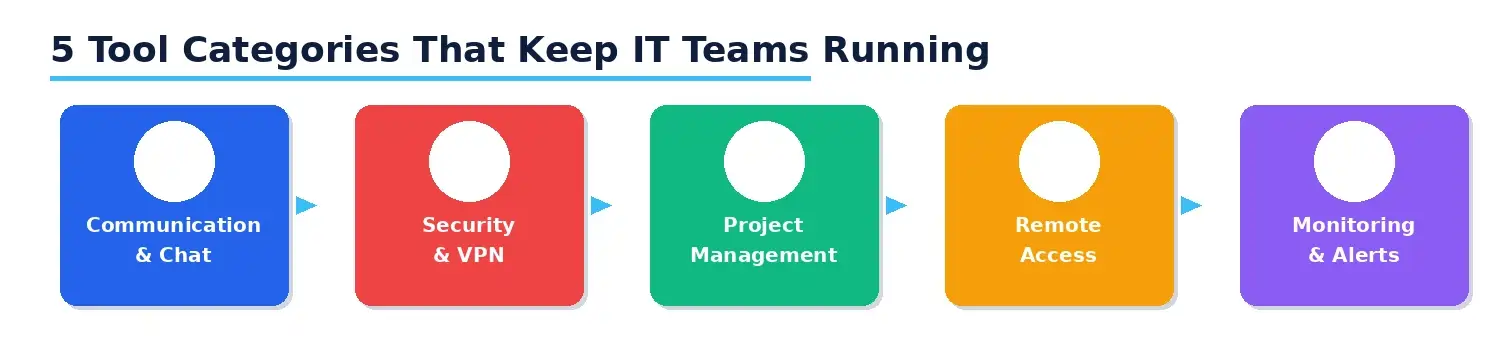
To handle this effectively, the right tools are essential. A well-designed remote IT toolkit ensures communication, security, productivity, and operational stability. This blog explores the core categories of tools that make remote IT work efficient and reliable.
- Communication and Collaboration Tools
Effective communication is the backbone of remote IT operations. It determines how quickly incidents are resolved, how smoothly teams collaborate, and how well knowledge is shared across time zones.
Slack is widely used in IT environments due to its channel-based structure, which organizes conversations by project, service, or incident. Its integrations with GitHub, Jira, and PagerDuty ensure real-time flow of alerts and updates.
Microsoft Teams is another popular choice, especially for organizations within the Microsoft ecosystem. It combines chat, video meetings, and document collaboration in a single platform, reducing the need to switch between tools.
Beyond tools, communication discipline is critical—clear channel usage, proper thread management, and consistent documentation ensure that remote teams remain aligned and informed.
- Security and Remote Access
Security becomes more complex in distributed environments where engineers connect from home networks, public Wi-Fi, or multiple locations.
Modern IT teams increasingly adopt Zero Trust Architecture, which assumes no user or device is inherently trusted. Every access request must be verified continuously. Tools like Tailscale and Cloudflare Access make Zero Trust practical without complex VPN setups.
Traditional VPNs such as NordLayer and Cisco AnyConnect remain common in enterprise environments, especially where legacy infrastructure exists. However, they can introduce latency and require careful configuration.
Multi-factor authentication (MFA) tools like Duo Security add an essential layer of protection by ensuring that compromised passwords alone cannot grant system access.
Together, these tools create a strong, layered security foundation for remote IT operations.
- Project and Ticket Management
Without structured tracking systems, remote IT workflows can quickly become disorganized. Project and ticketing tools act as the central source of truth for tasks, incidents, and development progress.
Jira is one of the most widely used platforms for agile project management and IT service tracking. It supports sprint planning, bug tracking, and workflow automation, though it can feel complex for smaller teams.
Linear offers a faster, more streamlined alternative, favored by engineering teams that prioritize simplicity and speed.
For IT support workflows, tools like Freshdesk and Zendesk help manage user tickets, track response times, and ensure proper escalation of issues.
Choosing the right platform depends on whether the focus is software development or service desk operations.
- Remote Desktop and Device Support
Supporting remote machines is a major challenge in distributed IT environments. Remote desktop tools enable technicians to access and troubleshoot systems without physical presence.
TeamViewer is a long-standing solution used globally for remote troubleshooting, software installation, and system repair.
AnyDesk is a lightweight alternative known for high performance even on low-bandwidth connections, making it ideal for geographically dispersed teams.
Splashtop is increasingly used in enterprise environments due to its strong security controls and endpoint management features, especially for managing large device fleets.
These tools significantly reduce downtime and improve support efficiency across distributed teams.
- Monitoring, Alerting, and Observability
Remote IT teams must maintain constant visibility into system health, as failures can occur at any time. Monitoring tools ensure issues are detected and resolved before they escalate.
Datadog provides a comprehensive observability platform covering infrastructure monitoring, application performance, logs, and security analytics. It also integrates with alerting systems and collaboration tools.
PagerDuty handles incident response and on-call scheduling, ensuring the right engineer is notified immediately when issues arise, regardless of location or time zone.
For teams preferring open-source solutions, Grafana combined with Prometheus offers a flexible and widely adopted monitoring stack for metrics visualization and alerting.
Together, these tools ensure proactive system monitoring and faster incident resolution.
Real-World Adoption
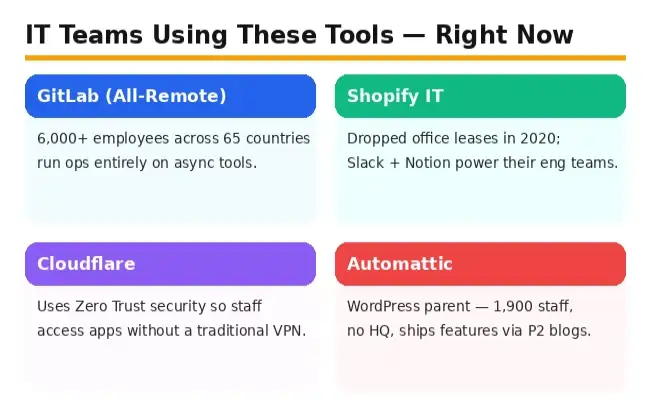
Leading organizations demonstrate the effectiveness of well-integrated remote IT toolchains.
GitLab operates as a fully remote company with globally distributed teams, relying heavily on asynchronous workflows and documented processes.
Shopify transitioned to a remote-first model and continues to use tools like Slack, GitHub, and Datadog to coordinate engineering operations across continents.
Cloudflare uses its own Zero Trust and security products internally, ensuring strong alignment between its tools and real-world operational needs.
These examples show that remote IT success depends on systems and tools, not physical proximity.
The Future of Remote IT Tools
The remote IT ecosystem continues to evolve rapidly.
AI-powered support systems in tools like Zendesk and Freshservice are automating ticket resolution, suggesting fixes, and improving response times.
Unified security platforms such as CrowdStrike Falcon and Microsoft Defender for Endpoint are consolidating multiple security functions into single ecosystems.
Async collaboration tools like Loom are reducing meeting dependency by enabling quick screen-recorded explanations and walkthroughs.
Infrastructure-as-Code platforms such as Terraform Cloud and Pulumi are improving collaboration in infrastructure management through version-controlled workflows.
Conclusion
Remote IT work is now a permanent part of the global technology landscape. Its success depends not only on skilled professionals but also on the strength of the tools they use.
The most effective teams treat their toolstack as critical infrastructure—selecting tools carefully, integrating them thoughtfully, and continuously refining workflows.
While no single tool solves every challenge, a well-balanced combination of communication, security, project management, support, and monitoring tools can transform remote work into a highly efficient operating model.
When implemented correctly, remote IT environments offer more than flexibility—they provide scalability, global collaboration, and operational resilience.