Author: Department of Artificial Intelligence & Machine Learning (AIML)
Introduction
Imagine a future in which diseases can be detected before a patient experiences any symptoms. A future where healthcare professionals can identify risks months or even years in advance, enabling preventive treatment rather than reactive care. Thanks to rapid advances in Artificial Intelligence (AI), this vision is steadily becoming a reality.
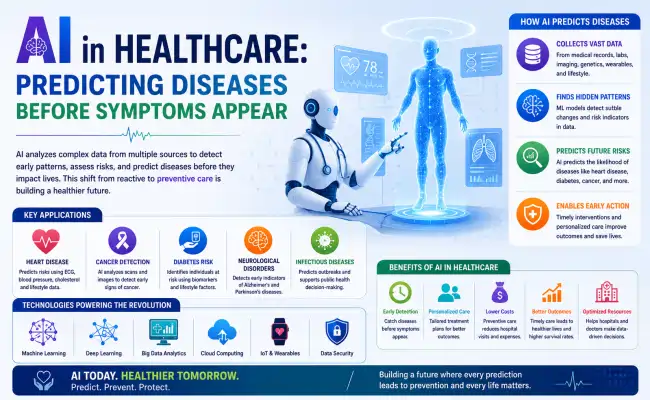
AI is transforming healthcare from a system focused primarily on treating illnesses to one centred on predicting and preventing them. By analysing vast quantities of medical data, AI-powered systems can uncover hidden patterns, identify anomalies, and forecast potential health conditions long before traditional diagnostic methods detect them. This capability has the potential to improve patient outcomes, reduce healthcare costs, and ultimately save lives.
For engineering students, the convergence of AI and healthcare represents one of the most exciting and socially impactful applications of modern technology.
The Evolution of Healthcare Through AI
For decades, healthcare has relied on clinical examinations, laboratory investigations, medical imaging, and physician expertise to diagnose diseases. While these methods remain fundamental to modern medicine, they typically identify illnesses only after symptoms have emerged.
Artificial Intelligence introduces a more proactive approach by leveraging technologies such as:
- Machine Learning (ML)
- Deep Learning
- Computer Vision
- Natural Language Processing (NLP)
- Predictive Analytics
- Big Data Technologies
Together, these technologies enable healthcare systems to process and analyse enormous volumes of patient information, identifying risks and trends that may not be immediately apparent to human experts.
How AI Predicts Diseases Before Symptoms Appear
AI systems are trained using extensive datasets that may include:
- Electronic Health Records (EHRs)
- Medical images
- Laboratory reports
- Genetic information
- Wearable device data
- Lifestyle and behavioural information
By learning from millions of historical patient records, AI algorithms can recognise subtle patterns associated with the early development of diseases.
For example, minor variations in heart rate, blood pressure, sleep quality, physical activity, or laboratory results may signal the onset of a medical condition. While these changes might appear insignificant when viewed individually, AI systems can identify meaningful patterns and provide early warnings before symptoms become noticeable.
Key Technologies Behind Predictive Healthcare
Machine Learning
Machine Learning algorithms analyse patient data to identify risk factors and predict future health outcomes.
Common applications include:
- Diabetes prediction
- Heart disease risk assessment
- Cancer screening support
- Kidney disease prediction
By continuously learning from new data, these systems become increasingly effective at recognising emerging health risks.
Deep Learning
Deep Learning models are particularly effective at processing complex medical data, including:
- X-rays
- CT scans
- MRI scans
- Pathology images
These systems can identify subtle abnormalities and patterns that may be difficult to detect through manual analysis, often achieving performance levels comparable to experienced medical professionals.
Wearable Health Monitoring
Modern smartwatches and fitness trackers continuously collect health-related data, including:
- Heart rate
- Blood oxygen levels
- Sleep patterns
- Physical activity levels
AI analyses this information in real time, helping identify potential health concerns and enabling earlier intervention when necessary.
Genomic Analysis
Advances in genomic sequencing have generated vast amounts of genetic data. AI accelerates the analysis of this information, helping researchers identify inherited disease risks and support the development of personalised treatment strategies tailored to individual patients.
Real-World Applications
Early Detection of Heart Disease
Cardiovascular diseases remain among the leading causes of death worldwide. AI models can analyse ECG readings, blood pressure measurements, medical history, and lifestyle factors to identify individuals at elevated risk of heart attacks and strokes before symptoms appear.
Cancer Prediction
AI-powered imaging systems can detect microscopic abnormalities within medical scans that may indicate the earliest stages of cancer. Early detection significantly improves treatment success rates and patient survival outcomes.
Diabetes Risk Assessment
Machine Learning models evaluate patient history, lifestyle patterns, and biometric indicators to estimate the likelihood of developing diabetes. This allows healthcare providers to recommend preventive measures before the condition progresses.
Neurological Disorders
Researchers are using AI to identify early indicators of neurological conditions such as Alzheimer’s disease and Parkinson’s disease through speech analysis, behavioural monitoring, and brain imaging data.
Infectious Disease Monitoring
AI can analyse large-scale public health data to predict disease outbreaks and support healthcare planning. During public health emergencies, predictive models help authorities allocate resources more efficiently and respond more effectively.
Benefits of AI-Driven Disease Prediction
The growing adoption of AI in healthcare offers several important benefits:
Early Intervention
Identifying diseases at an earlier stage enables faster treatment, reducing complications and improving patient outcomes.
Personalised Healthcare
AI supports customised treatment plans based on an individual’s health profile, genetic background, and risk factors.
Reduced Healthcare Costs
Preventing or managing diseases in their early stages is often significantly less expensive than treating advanced conditions.
Improved Accuracy
AI systems can process enormous datasets and identify complex patterns that might otherwise remain unnoticed.
Better Resource Management
Hospitals and healthcare organisations can use predictive insights to optimise staffing, equipment allocation, and patient care planning.
The Engineering Behind Predictive Healthcare
Predictive healthcare is a highly interdisciplinary field that combines expertise from several engineering and technology domains, including:
- Artificial Intelligence
- Machine Learning
- Data Science
- Cloud Computing
- Internet of Things (IoT)
- Biomedical Engineering
- Cybersecurity
- Software Development
Developing healthcare AI solutions requires knowledge of data processing, algorithm design, system integration, and secure information management. As a result, this field offers exciting career opportunities for engineers who wish to create technologies that directly improve quality of life and public health.
Challenges and Ethical Considerations
Despite its immense potential, AI-driven healthcare faces several important challenges.
Data Privacy: Healthcare information is highly sensitive and must be protected against unauthorised access and misuse.
Algorithm Bias: AI systems must be trained on diverse and representative datasets to ensure fair and accurate outcomes across different populations.
Regulatory Compliance: Healthcare technologies must comply with strict medical, legal, and ethical standards.
Human Oversight: AI should enhance clinical decision-making rather than replace medical professionals. Human judgement remains essential for ensuring safe and responsible patient care.
Addressing these challenges is crucial for building trust in AI-powered healthcare systems.
The Future of Predictive Healthcare
Healthcare is steadily moving towards a more preventive and data-driven model. Future AI systems will continuously monitor patient health, detect risks in real time, and recommend interventions before diseases develop.
Emerging technologies such as digital twins, personalised medicine, federated learning, and AI-powered diagnostic assistants are expected to further strengthen predictive healthcare capabilities.
Over the next decade, healthcare may increasingly focus on maintaining wellness rather than simply treating illness, supported by intelligent systems that help individuals lead healthier lives.
Conclusion
Artificial Intelligence is reshaping healthcare by making it possible to predict diseases before symptoms appear. Through Machine Learning, predictive analytics, wearable technologies, genomic analysis, and advanced medical imaging, AI is helping healthcare providers identify risks earlier, improve treatment outcomes, and move towards a preventive model of care.
For engineers, this transformation presents a unique opportunity to develop innovative solutions that combine computing, data science, and medical expertise. As AI continues to evolve, its role in predictive healthcare will become increasingly significant, creating a future in which technology not only treats disease but helps prevent it altogether.