 Author: Department of Computer Science & Engineering
Introduction
Imagine a fraud network consisting of ten fake accounts, three stolen phone numbers, and a single laptop used to conduct thousands of seemingly harmless transactions. Viewed individually, each activity appears legitimate — a £40 purchase here, a £60 withdrawal there. However, when these transactions are examined as part of a larger network of interconnected entities, a clear pattern of fraudulent behaviour emerges.
This is precisely the challenge that traditional fraud detection systems often struggle to address and where Graph Neural Networks (GNNs) demonstrate remarkable potential. Rather than evaluating transactions in isolation, GNNs analyse the complex web of relationships among users, accounts, devices, merchants, and transactions. As a result, they have rapidly become one of the most promising technologies in the fight against financial crime. This blog explores how Graph Neural Networks work, their applications in fraud detection, and the innovations shaping their future.
Why Fraud Detection Is More Like Solving a Puzzle Than Reading a List
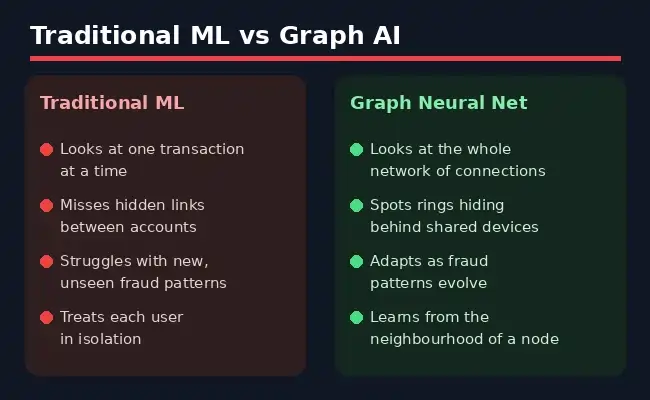
Conventional fraud detection systems are typically designed around a straightforward approach: evaluate a transaction, compare it against predefined rules or a machine learning model, and determine whether it appears suspicious.
This method works well for obvious cases. For example, a customer suddenly attempting to purchase multiple high-value items from a country they have never visited would likely trigger an alert. However, modern fraudsters rarely operate in such an obvious manner.
Instead, they distribute their activities across multiple accounts, reuse devices, share IP addresses, recycle email credentials, and create sophisticated networks designed to evade detection. The fraudulent activity often becomes visible only when these connections are examined collectively.
To identify such patterns, organisations need systems capable of understanding relationships rather than focusing solely on individual events. This is where graph-based approaches become invaluable.
Understanding Graph Neural Networks
A graph is a structure made up of nodes and edges. In fraud detection:
- Nodes may represent users, accounts, devices, merchants, or wallet addresses.
- Edges represent relationships such as transactions, shared devices, common addresses, or login activities.
Graph Neural Networks are machine learning models specifically designed to learn from these interconnected structures.
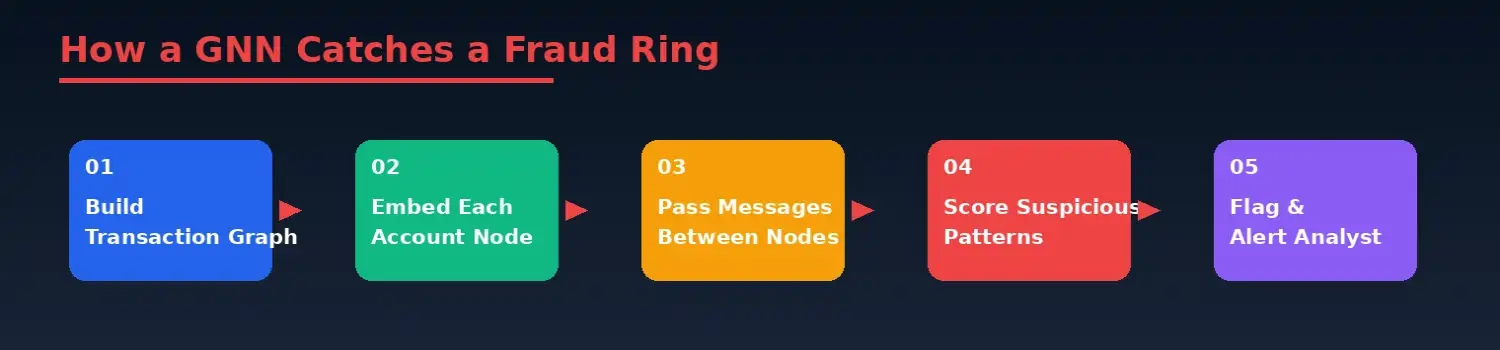
The process can be understood in a few simple steps:
- Initial Information Assignment
Each node begins with its own attributes. For example, an account may contain information such as account age, balance, transaction frequency, and geographic location. - Message Passing
Nodes exchange information with neighbouring nodes. This process, known as message passing, allows each entity to learn from the behaviour and characteristics of those directly connected to it. - Context Building
Through multiple rounds of information exchange, nodes develop a richer understanding not only of their own characteristics but also of the wider network around them. - Prediction and Classification
The model uses this enriched representation to determine whether a transaction, account, or entity exhibits suspicious behaviour.
The true strength of GNNs lies in their ability to uncover hidden relationships. An account that appears perfectly legitimate in isolation may become highly suspicious once the model discovers that it is connected to several other fraudulent accounts through shared devices, locations, or behavioural patterns.
Real-World Applications of GNNs in Fraud Detection
Many leading organisations are already leveraging graph-based intelligence to strengthen their fraud prevention capabilities.
PayPal
With billions of transactions processed annually, PayPal has publicly highlighted the value of graph-based deep learning in identifying coordinated fraud rings. These systems help uncover complex account-creation schemes and linked fraudulent activities that traditional models may overlook.
Mastercard
Mastercard incorporates graph-based artificial intelligence within its fraud prevention ecosystem. By analysing relationships across merchants, cardholders, and transactions in real time, the company can identify unusual spending patterns and flag potentially stolen card activity more effectively.
Insurance Industry
Insurance fraud often involves organised networks rather than isolated individuals. Graph models can reveal recurring connections among claimants, garages, medical professionals, and witnesses. Such insights help investigators identify staged accidents and coordinated fraudulent claims that would be difficult to detect manually.
Cryptocurrency and Blockchain Analytics
The cryptocurrency sector presents unique fraud challenges due to the large number of wallet addresses involved in transactions. Graph-based analysis enables organisations to trace the movement of stolen or laundered digital assets across extensive networks, helping investigators follow complex money trails despite attempts to conceal them.
Across all these examples, a common principle emerges: fraud is rarely an isolated event. Understanding relationships is often the key to identifying criminal activity.
Emerging Trends and Innovations
Graph Neural Networks continue to evolve rapidly, with several developments enhancing their effectiveness in fraud detection.
Dynamic Graphs
Traditional graph models often relied on static snapshots of data. Modern approaches increasingly focus on dynamic graphs that update continuously as new transactions occur. This allows fraud detection systems to identify emerging threats in near real time, reducing response times from hours to seconds.
Explainable Graph AI
One of the challenges facing advanced AI systems is explainability. Financial institutions and regulators require clear justifications for fraud alerts.
Emerging explainable AI techniques for GNNs aim to identify the specific relationships, nodes, and patterns that influenced a model’s decision. This improves transparency, supports regulatory compliance, and builds trust in automated systems.
Federated Graph Learning
Data sharing remains a significant challenge within the financial sector due to privacy regulations and competitive concerns. Federated graph learning offers a solution by enabling multiple institutions to collaboratively train fraud detection models without exchanging raw customer data.
This approach has the potential to create stronger industry-wide defences against fraud while preserving privacy and maintaining regulatory compliance.
Open-Source Development
The growth of frameworks such as PyTorch Geometric and Deep Graph Library has significantly lowered the barrier to entry for graph-based machine learning. Researchers, students, and industry professionals can now experiment with sophisticated GNN architectures more easily, accelerating innovation and expanding practical adoption.
Future Scope
As fraud schemes become increasingly sophisticated, automated, and interconnected, fraud detection technologies must continue to evolve.
Graph Neural Networks are expected to become a standard component of modern fraud prevention systems, complementing other artificial intelligence techniques. For example:
- Natural Language Processing (NLP) can help detect phishing attempts and fraudulent communications.
- Computer Vision can identify forged documents and manipulated images.
- Graph-based models can uncover hidden relationships among suspicious entities.
An especially promising direction is the integration of GNNs with Large Language Models (LLMs). Such systems could enable fraud analysts to ask natural-language questions such as, “Why was this account flagged?” and receive clear, human-readable explanations based on the underlying graph structure and detected patterns.
This combination could significantly improve both operational efficiency and decision transparency.
Conclusion
Fraud has always relied on hidden connections, and for many years those connections remained difficult to identify. Graph Neural Networks represent a major advancement because they place relationships at the centre of analysis rather than treating them as secondary information.
Whether it is a bank preventing stolen card transactions, an insurance company uncovering organised claim fraud, or a cryptocurrency platform tracing illicit funds, the underlying principle remains the same: understanding the network reveals insights that individual data points cannot.
As Graph Neural Networks continue to mature, they are poised to play an increasingly important role in protecting organisations and consumers from financial crime. The future of fraud detection will not simply depend on smarter algorithms, but on smarter ways of understanding the complex networks in which fraud operates.