
 Author: Dr. Mohammad Baquir
As cities continue to expand and energy demands increase, engineers and researchers are searching for technologies that can address two major challenges simultaneously: sustainable energy production and effective wastewater management. Among the many innovations being explored, Microbial Fuel Cells (MFCs) have attracted significant attention because they offer the possibility of generating electricity while treating wastewater.
Although the idea of bacteria producing electricity may sound like science fiction, it is firmly rooted in established scientific principles. While MFCs are unlikely to replace conventional power stations in the foreseeable future, they represent an exciting area of research with the potential to make wastewater treatment more energy-efficient and environmentally sustainable.
What Is a Microbial Fuel Cell?
A Microbial Fuel Cell is a bioelectrochemical device that converts the metabolic activity of microorganisms directly into electrical energy. Simply put, certain bacteria release electrons as they break down organic matter in oxygen-free environments. Rather than allowing these electrons to remain within the microbial system, an MFC captures them and directs them through an external electrical circuit, generating a measurable electric current.
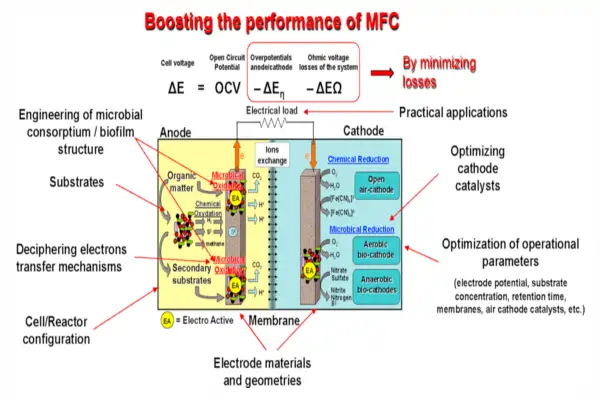
A typical MFC consists of two chambers separated by a proton exchange membrane.
The anode chamber is anaerobic (oxygen-free) and contains organic waste materials such as wastewater, sewage sludge, or food waste along with electroactive bacteria, including Geobacter sulfurreducens and Shewanella oneidensis. As these microorganisms oxidise organic compounds, they release electrons to the anode and protons into the surrounding solution.
The electrons then travel through an external circuit to the cathode, producing electricity along the way. At the cathode, the electrons combine with oxygen and protons to form water, completing the electrical circuit.
The remarkable aspect of this process is that while electricity is being generated, the bacteria are simultaneously consuming the organic pollutants present in wastewater. As a result, the water is treated as part of the same biological process.
Why Is This Technology Important?
Traditional wastewater treatment plants rely heavily on the activated sludge process, which requires substantial energy to supply oxygen for aerobic microorganisms. These systems typically consume 0.3–0.6 kWh of electricity for every cubic metre of wastewater treated.
In India, where less than one-third of urban wastewater currently receives adequate treatment, the energy required to operate sewage treatment plants represents a major financial challenge for municipalities. In many cases, electricity costs account for 30–40% of operational expenditure, limiting the expansion of treatment infrastructure.
Microbial Fuel Cells offer a fundamentally different approach. Instead of consuming energy to remove pollutants, they recover part of the chemical energy already stored within wastewater.
Research suggests that MFC-based systems could theoretically recover 40–60% of the chemical energy contained in organic waste. Although only a proportion of this energy is converted into electricity, even partial energy recovery could significantly reduce the overall energy demand of wastewater treatment facilities.
Rather than viewing sewage solely as waste requiring disposal, MFC technology encourages engineers to consider it as a valuable energy resource.
Engineering Challenges: Where Theory Meets Practice
Despite their promise, Microbial Fuel Cells present several engineering challenges that must be overcome before they can be implemented on a large scale.
Electrode Materials
The electrodes form the heart of an MFC and must satisfy several demanding requirements. They need to conduct electricity efficiently, resist chemical corrosion, remain biologically stable, and be economically viable.
Carbon-based materials such as graphite felt, carbon cloth, and carbon fibre brushes provide excellent electrochemical performance. However, they remain expensive when scaled to the sizes required for municipal wastewater treatment plants. This continues to be one of the most significant barriers to commercial adoption.
Hydraulic Retention Time
Another important consideration is hydraulic retention time—the period during which wastewater remains inside the reactor.
Electroactive bacteria require sufficient contact time with organic matter to complete the oxidation process effectively. Most MFC systems require retention times between 6 and 24 hours, similar to conventional anaerobic digesters.
Longer retention times mean larger reactor volumes, increasing both construction costs and land requirements. In densely populated Indian cities, where land availability is already limited, this presents a considerable design challenge.
Membrane Technology
Laboratory-scale MFCs commonly use Nafion proton exchange membranes because of their excellent performance. Unfortunately, Nafion is prohibitively expensive for large-scale wastewater treatment and gradually deteriorates under real operating conditions.
Researchers are therefore investigating affordable alternatives, including ceramic membranes, terracotta separators, and locally available earthen materials. These options are particularly relevant for India, where low-cost construction materials are widely available and could make MFC technology more economically feasible.
Promising Real-World Applications
Although city-scale electricity generation remains a distant goal, several practical applications of MFC technology are already showing considerable promise.
Powering Remote Environmental Sensors
Sediment-based MFCs can be installed beneath riverbeds and lake sediments, where naturally occurring organic matter provides a continuous energy source. These systems are capable of powering remote water-quality monitoring sensors without batteries or grid electricity.
Given India’s extensive river network and ongoing challenges in environmental monitoring, this application could provide substantial long-term benefits.
Real-Time Water Quality Monitoring
The electrical output produced by an MFC is directly related to the amount of biodegradable organic matter present in wastewater. This enables the system to function as a continuous Biochemical Oxygen Demand (BOD) sensor.
Unlike conventional laboratory testing, which requires time-consuming sample collection and analysis, MFC-based sensors can provide real-time monitoring of treatment plant performance, improving operational efficiency while reducing costs.
Constructed Wetland–MFC Hybrid Systems
One of the most promising developments combines Microbial Fuel Cells with constructed wetlands.
In these hybrid systems, electrodes are integrated within wetland beds. Plant roots naturally supply oxygen to the cathode region, while the waterlogged soil provides ideal anaerobic conditions around the anode.
The result is a sustainable treatment system that purifies wastewater, generates small amounts of electricity, enhances biodiversity, and requires minimal mechanical maintenance. Such systems could be particularly valuable for peri-urban communities and rural regions across India.
Current Limitations
Despite encouraging progress, several important obstacles prevent widespread deployment.
Long-term electrode performance under real wastewater conditions is not yet fully understood. Biological fouling, fluctuating pH levels, and varying wastewater composition all affect system efficiency.
Similarly, microbial communities behave differently outside laboratory conditions. High-performing bacterial species used in controlled experiments are often replaced by more competitive microorganisms when exposed to municipal wastewater.
From an engineering perspective, there is currently no universally accepted design methodology, no dedicated Indian Standards (IS) code, and only limited operational expertise for large-scale MFC installations.
Finally, the cost of generating electricity using Microbial Fuel Cells remains significantly higher than that of established renewable technologies such as solar and wind energy. At present, electricity generation alone cannot justify widespread implementation.
Looking Ahead
Microbial Fuel Cells are unlikely to power entire cities within the next decade—or perhaps even the next two decades. However, evaluating this technology solely by the amount of electricity it produces overlooks its true significance.
Its greatest value lies in enabling energy-neutral wastewater treatment, improving remote environmental monitoring, and encouraging a more sustainable approach to waste management.
For Civil Engineers, environmental scientists, and researchers, MFCs represent an exciting interdisciplinary field where biology, chemistry, materials science, and engineering converge to address some of society’s most pressing infrastructure challenges.
As research continues and costs decline, Microbial Fuel Cells may not replace conventional power generation, but they could fundamentally change how we treat wastewater. Rather than seeing sewage as a costly disposal problem, future engineers may increasingly recognise it as a renewable resource capable of producing clean energy while protecting the environment.
Such a shift in perspective could become one of the most important contributions of Microbial Fuel Cell technology to sustainable urban development.