Author: Department of Artificial Intelligence & Machine Learning
Artificial Intelligence (AI) has moved beyond being a futuristic concept to become one of the most influential technologies of the modern world. From virtual assistants and personalised recommendations to autonomous vehicles and advanced healthcare diagnostics, AI is transforming the way we live and work. As organisations across industries continue to invest in intelligent technologies, the demand for skilled AI professionals is growing rapidly.
For students considering a career in Artificial Intelligence and Machine Learning (AI & ML), there has never been a better time to begin preparing. Success in this field requires more than academic knowledge—it demands curiosity, practical experience, continuous learning, and adaptability.
This roadmap outlines the key stages students can follow to become industry-ready AI Engineers by 2027 while also helping parents understand how they can support this exciting career journey.
Why Choose a Career in AI Engineering?
AI Engineers design, build, and deploy intelligent systems capable of learning from data, recognising patterns, and solving complex problems. Their work influences sectors including healthcare, finance, education, manufacturing, cyber security, retail, and entertainment.
A career in AI Engineering offers several advantages:
- High demand across a wide range of industries.
- Excellent career growth and competitive salary packages.
- Opportunities to work with cutting-edge technologies.
- The chance to solve real-world problems through innovation.
- Global employment opportunities.
- Continuous learning in a rapidly evolving field.
As AI becomes increasingly integrated into everyday life, skilled professionals will remain at the forefront of technological innovation.
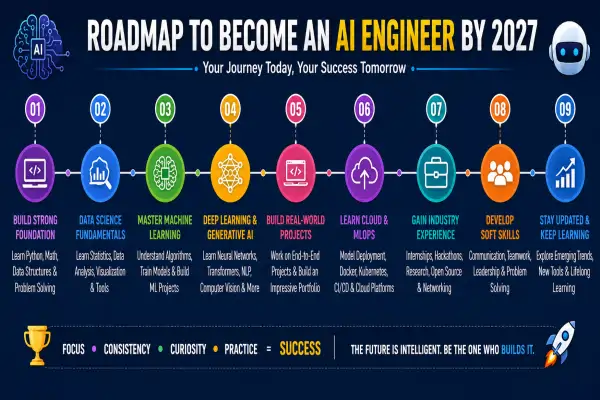
Year One: Build Strong Foundations
Every successful AI Engineer begins with a solid understanding of mathematics and programming.
Students should focus on developing their knowledge of Linear Algebra, Calculus, Probability, and Statistics, as these subjects underpin many AI algorithms. At the same time, they should become proficient in Python, the most widely used programming language in AI development, while also understanding the fundamentals of C/C++ and Data Structures.
Beyond technical knowledge, students should cultivate logical reasoning, algorithmic thinking, and problem-solving skills through coding challenges and small programming projects. Building these foundations early makes learning advanced AI concepts much easier.
Year Two: Learn the Fundamentals of Data Science
Artificial Intelligence depends on data. Before machines can learn, data must be collected, organised, analysed, and interpreted effectively.
During the second year, students should study Data Analysis, Statistics, Exploratory Data Analysis (EDA), and Data Visualisation. Familiarity with tools such as NumPy, Pandas, Matplotlib, and Jupyter Notebook will enable them to work efficiently with real-world datasets.
Practical projects—such as analysing student performance, visualising sales trends, or predicting weather patterns—help students understand how data can be transformed into meaningful insights.
Year Three: Master Machine Learning
Machine Learning forms the core of modern Artificial Intelligence. At this stage, students should develop a thorough understanding of supervised, unsupervised, and reinforcement learning techniques.
They should become familiar with widely used algorithms, including Linear Regression, Logistic Regression, Decision Trees, Random Forests, K-Means Clustering, and Support Vector Machines. Experience with industry-standard libraries such as Scikit-learn, TensorFlow, and PyTorch is equally important.
Projects such as house price prediction, spam email detection, and customer churn prediction allow students to apply theoretical knowledge to practical business challenges while strengthening their technical portfolio.
Explore Deep Learning and Generative AI
Modern AI applications increasingly rely on Deep Learning and Generative AI technologies.
Students should learn about Artificial Neural Networks (ANNs), Convolutional Neural Networks (CNNs), Recurrent Neural Networks (RNNs), Transformers, and Large Language Models (LLMs). These technologies power applications such as image recognition, speech processing, intelligent chatbots, and AI-generated content.
Building projects involving image classification, conversational chatbots, text summarisation, or AI content generation enables students to gain valuable hands-on experience while exploring some of the most exciting areas of modern AI.
Develop Practical Projects and Build a Portfolio
Employers increasingly value practical experience alongside academic qualifications. Developing real-world projects demonstrates both technical competence and problem-solving ability.
Students could create applications such as:
- Smart Attendance Systems.
- Face Recognition Systems.
- AI-based Resume Screening Tools.
- Medical Diagnosis Assistants.
- Traffic Prediction Systems.
- Financial Fraud Detection Models.
- Personalised Learning Recommendation Systems.
Completed projects should be uploaded to GitHub, documented clearly, and supported by technical blogs or project reports. A well-maintained portfolio provides tangible evidence of skills and significantly strengthens employment prospects.
Understand Cloud Computing and MLOps
Developing AI models is only part of the journey. Organisations also need professionals who can deploy, monitor, and maintain AI systems in production environments.
Students should therefore gain experience with Cloud Computing platforms such as Amazon Web Services (AWS), Microsoft Azure, and Google Cloud Platform. Learning Docker, Kubernetes, model deployment techniques, and CI/CD pipelines introduces students to Machine Learning Operations (MLOps), an increasingly valuable skill within the industry.
Gain Industry Experience
Practical industry exposure is invaluable. Students should actively seek internships, industry-sponsored projects, hackathons, research opportunities, and open-source contributions throughout their academic journey.
These experiences not only strengthen technical skills but also improve teamwork, professional networking, confidence, and employability.
Develop Professional Skills
Technical expertise alone is not enough to succeed in today’s workplace. AI Engineers regularly collaborate with software developers, business analysts, project managers, and clients from non-technical backgrounds.
Students should therefore develop strong communication, teamwork, leadership, presentation, time management, and critical thinking skills. These qualities enable professionals to explain complex AI concepts clearly and contribute effectively within multidisciplinary teams.
Stay Ahead of Emerging Technologies
Artificial Intelligence evolves rapidly, making continuous learning essential.
Students should regularly explore developments in:
- Generative AI.
- AI Agents.
- Explainable AI (XAI).
- Edge AI.
- AI Cyber Security.
- Multimodal AI.
- Responsible AI.
- AI applications in Healthcare and Education.
Reading research articles, attending webinars, participating in technical communities, and completing certifications in Python, Data Science, Machine Learning, Deep Learning, Cloud Computing, Generative AI, and MLOps will further strengthen professional profiles.
A Message for Parents and Guardians
Parents play an important role in helping students succeed. Encouraging curiosity, creativity, independent thinking, and project-based learning is just as valuable as academic achievement. Supporting participation in coding competitions, hackathons, internships, and online learning opportunities can help students develop the confidence and practical skills needed for future careers.
The most successful AI professionals are lifelong learners who continuously adapt to new technologies and embrace innovation.
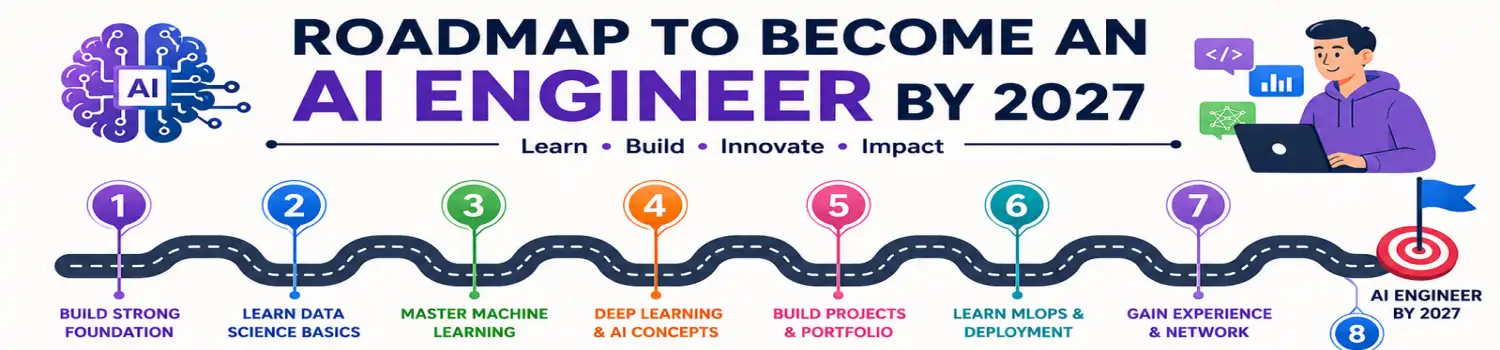
The AI Engineer Roadmap at a Glance
Year 1: Programming fundamentals, Mathematics, Data Structures
Year 2: Data Science, Statistics, Data Visualisation
Year 3: Machine Learning, Deep Learning, AI Projects
Year 4: Generative AI, MLOps, Internships, Industry Projects
By 2027: Graduate as an industry-ready AI Engineer equipped with both technical expertise and practical experience.
Conclusion
The journey to becoming an AI Engineer in 2027 is both challenging and rewarding. Students who build strong technical foundations, gain practical experience, remain curious, and embrace continuous learning will be well prepared for one of the world’s fastest-growing professions.
Artificial Intelligence is more than a technological revolution—it is an opportunity to develop solutions that improve lives, transform industries, and shape the future. By combining knowledge, innovation, and perseverance, today’s students can become tomorrow’s AI leaders.