Author: Department of Information Technology
Artificial Intelligence (AI) is no longer a technology confined to research laboratories or science fiction. It has become an integral part of modern workplaces, transforming how organisations operate, make decisions, and deliver services. From software development and cyber security to cloud computing and business analytics, AI is enabling professionals to work faster, smarter, and more efficiently than ever before.
For Information Technology (IT) students, this rapid evolution should be viewed as an opportunity rather than a threat. The careers of the future will not be defined by humans competing with AI, but by professionals who know how to work alongside intelligent technologies. Developing the right combination of technical expertise and human skills will be the key to long-term success.
AI: Enhancing Human Potential
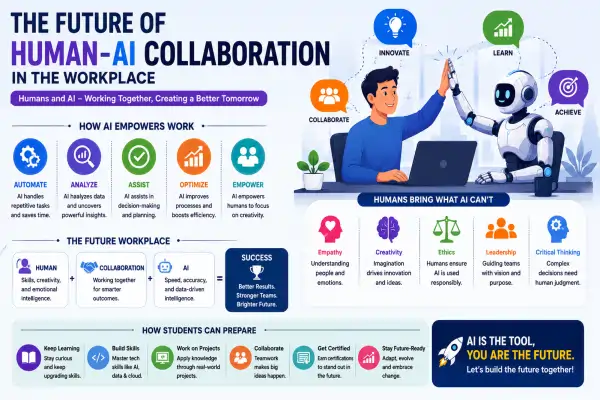
A common concern among students is that AI will eventually replace human jobs. In reality, AI is changing the way work is performed rather than eliminating the need for skilled professionals. It excels at processing information, recognising patterns, and automating repetitive tasks, allowing people to focus on work that requires creativity, judgement, and collaboration.
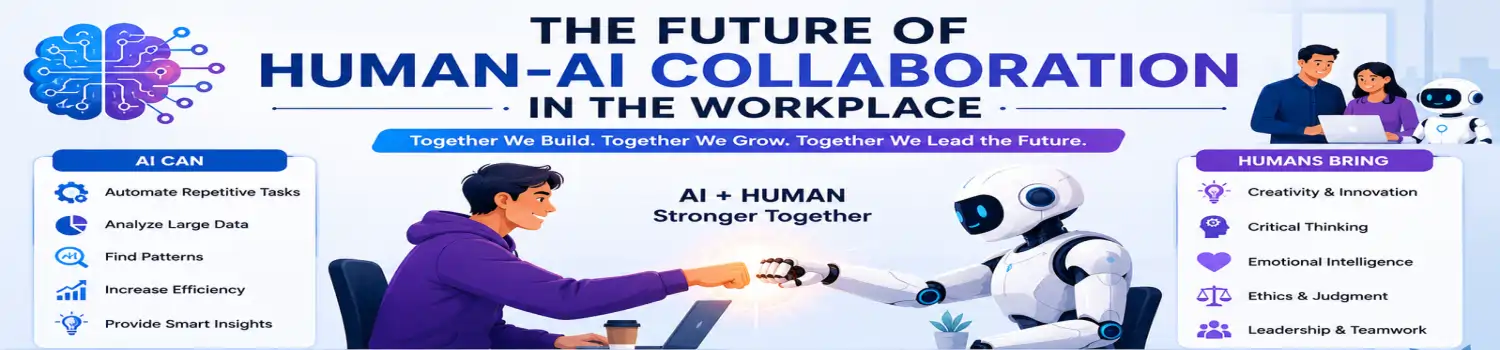
AI can:
- Analyse large volumes of data in seconds.
- Automate routine and repetitive tasks.
- Identify patterns, trends, and anomalies.
- Support quicker and more informed decision-making.
However, people continue to provide qualities that technology cannot fully replicate, including:
- Creativity and innovation.
- Critical thinking.
- Emotional intelligence.
- Ethical judgement.
- Leadership and teamwork.
The future workplace will value individuals who can combine these human strengths with the capabilities of AI-powered tools.
The Growing Impact of AI Across the IT Industry
Artificial Intelligence is reshaping every major area of Information Technology.
Software Development
Modern AI coding assistants help developers generate code, identify errors, and optimise applications more efficiently. This enables software engineers to spend more time designing innovative solutions and improving user experiences rather than completing repetitive coding tasks.
Cyber Security
AI has become an essential tool for detecting cyber threats, monitoring network activity, and identifying suspicious behaviour in real time. Security professionals can respond more quickly to attacks while strengthening organisational resilience against increasingly sophisticated cyber risks.
Data Analytics
Businesses generate enormous amounts of information every day. AI allows organisations to analyse these datasets efficiently, uncover valuable insights, predict future trends, and support evidence-based decision-making.
Cloud Computing
AI enhances cloud environments by optimising resource allocation, monitoring system performance, and automating routine maintenance. This improves efficiency while reducing operational costs.
Network Management
Intelligent monitoring systems can predict potential failures before they occur, enabling IT teams to resolve issues proactively and minimise service disruptions.
Emerging Career Opportunities
The widespread adoption of AI is creating exciting new career paths for graduates with the right knowledge and skills. Some of the fastest-growing roles include:
- AI Engineer
- Machine Learning Engineer
- Data Scientist
- AI Product Manager
- Cyber Security Analyst
- Cloud AI Specialist
- AI Solutions Architect
- Prompt Engineer
- AI Ethics Consultant
These careers offer excellent prospects for professional growth, continuous learning, and long-term employability as organisations increasingly invest in AI-driven technologies.
Essential Skills for Future IT Professionals
Success in an AI-enabled workplace requires more than technical knowledge alone. Students should focus on developing a balanced skill set.
Programming Fundamentals
Programming remains the foundation of every IT career. Languages such as Python, Java, JavaScript, and C++ continue to be widely used in AI development, software engineering, and systems design.
Data Literacy
Understanding how to collect, analyse, interpret, and visualise data has become essential across almost every technology role. Organisations increasingly rely on data to drive strategic decisions.
AI and Machine Learning
Students should build a basic understanding of Machine Learning, Deep Learning, Natural Language Processing, and Generative AI. Even professionals who do not specialise in AI will benefit from understanding how these technologies are applied in industry.
Cloud Computing
Practical experience with platforms such as Amazon Web Services (AWS), Microsoft Azure, and Google Cloud Platform will significantly improve career prospects, as cloud technologies underpin many modern AI applications.
Cyber Security
As digital systems become more intelligent and interconnected, protecting data and infrastructure is more important than ever. Every IT professional should understand the fundamentals of cyber security.
Professional Skills
Alongside technical expertise, employers increasingly value graduates who demonstrate:
- Communication skills.
- Leadership potential.
- Teamwork.
- Problem-solving ability.
- Adaptability.
- A commitment to continuous learning.
These capabilities enable professionals to work effectively in multidisciplinary teams and adapt to rapidly evolving technologies.
The Human Skills AI Cannot Replace
Although AI can process information with remarkable speed and accuracy, several uniquely human qualities remain indispensable.
Creativity enables people to develop original ideas and innovative solutions.
Empathy helps professionals understand customer needs, build relationships, and collaborate effectively with colleagues.
Ethical judgement ensures that AI technologies are developed and applied responsibly, fairly, and transparently.
Strategic thinking allows individuals to make informed decisions by balancing technical possibilities with organisational goals and human values.
As AI continues to advance, these human-centred skills will become even more valuable in the workplace.
Preparing for the Future Today
Students can begin preparing for AI-enabled careers while they are still studying.
Developing practical projects such as AI chatbots, recommendation systems, smart applications, or data analytics dashboards provides valuable hands-on experience and strengthens a professional portfolio.
Participating in hackathons encourages innovation, teamwork, and creative problem-solving while exposing students to real-world challenges.
Professional certifications in Cloud Computing, Artificial Intelligence, Machine Learning, Cyber Security, and Data Analytics can further enhance employability and demonstrate a commitment to lifelong learning.
Most importantly, students should remain curious. Technology continues to evolve rapidly, and successful IT professionals are those who embrace change and continuously update their knowledge.
A Message for Parents and Guardians
The workforce of the future will require graduates who possess both technical competence and strong interpersonal skills. Parents and guardians can support this journey by encouraging curiosity, creativity, critical thinking, communication, and digital literacy alongside academic achievement. These qualities will enable students to adapt confidently to an AI-driven world and build successful, sustainable careers.
Conclusion
Artificial Intelligence is transforming the workplace, but it is not replacing the need for talented professionals. Instead, it is changing how work is performed and creating exciting opportunities for individuals who are prepared to work alongside intelligent technologies.
For IT students, the future belongs to those who embrace innovation, develop strong technical foundations, and cultivate the human skills that machines cannot replicate. By combining programming expertise, AI knowledge, problem-solving ability, and a commitment to lifelong learning, today’s students can become tomorrow’s technology leaders.
As the saying goes:
“AI will not replace people. People who know how to use AI effectively will shape the future.”
The digital workplace of tomorrow will be built by adaptable, innovative, and collaborative professionals. The journey towards that future begins with the choices students make today.