
 Author: Dr. Shivangi
Department: Department of Civil Engineering
Civil Engineering has long been the foundation of modern development, shaping the roads, bridges, buildings, and infrastructure that support economic growth and improve quality of life. However, the profession is evolving rapidly. Urbanisation, climate change, technological innovation, and the emergence of smart infrastructure are transforming the skills expected of today’s civil engineers.
Graduates entering the profession over the next few years will face a very different industry from that of previous generations. Employers now seek professionals who combine sound engineering knowledge with digital competence, sustainability awareness, project management abilities, and strong communication skills. As the construction industry moves towards 2030, students must prepare themselves with competencies that enable a smooth transition from the classroom to real-world engineering projects.
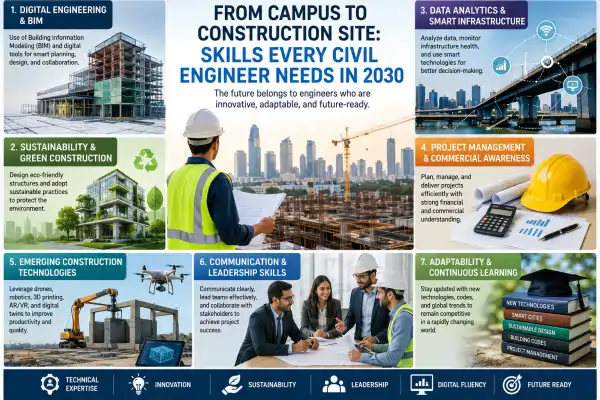
Digital Engineering and Building Information Modelling (BIM)
Traditional drawings and manual calculations are increasingly being replaced by digital workflows. Building Information Modelling (BIM) has become one of the most important technologies in modern construction, enabling architects, engineers, contractors, and project managers to collaborate using a shared digital model throughout a project’s lifecycle.
By improving coordination, reducing design conflicts, and enhancing project visualisation, BIM contributes to greater efficiency and cost savings. Civil engineers entering the workforce in 2030 will be expected to understand digital project environments, model coordination, and integrated project delivery. Familiarity with BIM and other digital construction tools is rapidly becoming an essential professional skill rather than an added advantage.
Sustainability and Green Construction
Sustainability has become a fundamental requirement in infrastructure development. Governments and industries are increasingly adopting environmentally responsible construction practices that minimise resource consumption, reduce carbon emissions, and improve long-term resilience.
Future civil engineers should understand sustainable design principles, energy-efficient buildings, water conservation techniques, environmentally friendly materials, and waste management strategies. Green buildings, rainwater harvesting, and renewable energy integration are becoming standard features of modern infrastructure. Engineers who successfully balance development with environmental responsibility will play a key role in creating sustainable communities.
Smart Infrastructure and Data Analytics
Modern infrastructure is becoming increasingly intelligent through the integration of sensors, Internet of Things (IoT) devices, and real-time monitoring systems. Bridges can monitor their structural health, highways can analyse traffic patterns, and buildings can optimise energy consumption using smart technologies.
Civil engineers must develop the ability to interpret data, identify trends, and support informed decision-making. Knowledge of infrastructure monitoring, predictive maintenance, and smart city technologies will help improve safety, reduce maintenance costs, and extend the lifespan of critical assets. As smart cities continue to expand, engineers with both civil and digital expertise will be in high demand.
Project Management and Commercial Awareness
Large infrastructure projects involve multiple stakeholders, strict schedules, financial constraints, and regulatory requirements. Consequently, technical knowledge alone is no longer sufficient.
Civil engineers should develop project management skills such as planning, scheduling, resource allocation, budgeting, and risk management. An understanding of contracts, procurement procedures, and construction economics also enables engineers to contribute more effectively to project delivery. Professionals who combine technical competence with managerial ability often progress more quickly into supervisory and leadership roles.
Emerging Construction Technologies
Technological innovation continues to reshape the construction industry. Drones are widely used for surveying and site inspections, robotics assist with repetitive construction activities, and 3D printing is opening new possibilities for building components and structural systems.
Emerging technologies such as digital twins, augmented reality, and automated construction equipment are expected to become increasingly common during the coming decade. Engineers who remain familiar with these developments will be better equipped to improve productivity, reduce costs, and enhance project quality. Continuous learning and adaptability will therefore become defining characteristics of successful civil engineers.
Communication, Leadership, and Lifelong Learning
Civil engineering projects require close collaboration among architects, contractors, consultants, government agencies, suppliers, and clients. Engineers must therefore communicate technical information clearly through reports, presentations, meetings, and site discussions. Strong leadership and interpersonal skills also improve teamwork, decision-making, and conflict resolution, enabling projects to progress more efficiently.
Equally important is a commitment to lifelong learning. Professional certifications, workshops, industry training programmes, and technical seminars help engineers remain current with evolving technologies, regulations, and construction practices. Those who continuously upgrade their knowledge are more likely to remain competitive throughout their careers.
Preparing Students for the Future
Educational institutions play a vital role in preparing graduates for the changing demands of the construction industry. At Ambalika Institute of Management and Technology, the Civil Engineering programme focuses on developing technical competence alongside practical industry readiness.
Students are encouraged to participate in laboratory work, technical workshops, industrial visits, seminars, and project-based learning that expose them to real engineering challenges. These experiences help bridge the gap between classroom learning and professional practice while strengthening problem-solving, teamwork, and innovation.
Conclusion
The transition from campus to construction site in 2030 will require far more than traditional engineering knowledge. Civil engineers must combine technical expertise with digital skills, sustainability awareness, project management capabilities, communication, and leadership to succeed in an increasingly technology-driven industry.
For today’s students, the future presents exciting opportunities to contribute to smart cities, sustainable infrastructure, and innovative construction practices. By developing these skills early and embracing continuous learning, aspiring civil engineers can build successful careers while helping shape the resilient and sustainable infrastructure of tomorrow.