 Author: Dr. Devendra
Artificial Intelligence is no longer just a buzzword discussed in technology conferences. It has become part of everyday engineering and business. From chatbots that answer customer queries to systems that predict machine failures before they occur, AI is transforming industries across the world.
As a result, students and young professionals are increasingly asking an important question: “Should I pursue an AI certification, and which one is worth my time?”
With hundreds of courses available online, choosing the right certification can be confusing. The good news is that you do not need to complete every course you find. A few well-recognised certifications, combined with practical projects, can make a meaningful difference to your career.
Why Certifications Still Matter
Many students wonder whether certificates are still useful when free tutorials are available everywhere. The answer is yes, but only when combined with practical learning.
A recognised certification gives recruiters a quick way to verify that you have studied key AI concepts. When two candidates have similar academic qualifications, a relevant AI certification can help one résumé stand out.
However, a certificate alone rarely guarantees a job. Employers are often more impressed by students who have built something real, such as a chatbot, a recommendation system, a computer vision application, or a simple AI-powered automation tool. Think of certifications as proof of learning and projects as proof of doing.
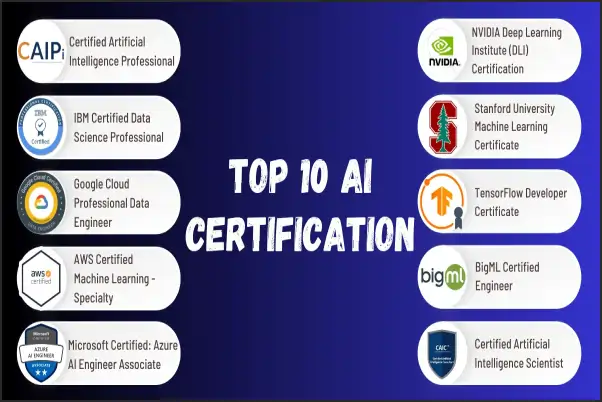
AI Certifications Worth Considering
- Microsoft Azure AI Fundamentals
This is one of the best beginner-friendly certifications available today. It introduces machine learning, computer vision, natural language processing, and responsible AI without requiring advanced mathematics or programming skills. Students who are completely new to AI will find it an excellent starting point.
- Google AI Essentials
Offered through Coursera, this certificate focuses on using AI effectively in everyday work. Learners explore prompt writing, understand the strengths and limitations of generative AI, and discover practical ways to improve productivity. It is especially useful for students from non-technical backgrounds who want to become confident AI users.
- IBM AI Foundations / Generative AI Engineering
IBM’s programmes provide more hands-on experience. Learners work with large language models, prompt engineering, and tools such as LangChain that are increasingly used in modern AI applications and chatbots. These courses are well suited for students interested in building real AI applications.
- AWS Certified Machine Learning Associate
Students interested in training models, deploying machine learning solutions, and working with cloud-based AI systems should consider this certification. It is more technical and is best suited for learners who already have some experience with Python and data handling.
- Google Professional Machine Learning Engineer
This certification is aimed at students aspiring to become machine learning engineers. It tests the ability to design, build, deploy, and optimise ML models on Google Cloud. Because of its difficulty level, it is usually best attempted after gaining foundational knowledge and project experience.
- CompTIA AI+
CompTIA AI+ is vendor-neutral, meaning it is not tied to a single cloud platform. It covers AI concepts, ethics, and practical applications broadly, making it a good choice for students who want a general understanding of AI across industries.
How to Choose the Right Certification
Instead of collecting multiple certificates, focus on one that matches your current level and career goals.
Ask yourself:
- Are you a beginner? Start with Azure AI Fundamentals or Google AI Essentials.
- Do you enjoy coding and building AI systems? Consider AWS or Google’s ML Engineer pathway.
- Are you interested in using AI in business, management, or design? A foundational certificate is usually sufficient.
- Does the certification align with the cloud platform used in your college projects? Choosing a matching platform helps reinforce existing skills.
One well-chosen certification completed thoroughly is often more valuable than several certificates earned superficially.
A Practical Example
Consider a final-year Mechanical Engineering student who completes Google AI Essentials and then builds a simple Python project that predicts machine downtime using sensor data. Even though the student’s core branch is not Computer Science, the combination of a recognised certificate and a practical project can make the résumé stand out during campus placements.
This highlights an important trend: AI skills are becoming valuable across all engineering branches, including Mechanical, Civil, Electrical, Electronics, and Biotechnology—not just CSE and IT.
Beyond Certifications: Build Something
Certifications are a great starting point, but real growth comes from applying what you learn.
Students should participate in AI workshops, hackathons, open-source projects, and small automation tasks. Even a simple AI-powered tool that solves a real problem can demonstrate initiative and practical ability.
Employers increasingly look for candidates who can learn independently, experiment with new tools, and build useful solutions.
Conclusion
AI certifications can strengthen your résumé and boost your confidence, but they work best as a stepping stone rather than a finish line. Choose one certification that matches your current skill level, complete it seriously, and apply the knowledge through a practical project.
That combination of certified knowledge and real-world application is what truly helps students stand out in today’s competitive, AI-driven job market.
The most important step is not choosing the “perfect” certification—it is simply getting started.