 Author: Department of Artificial Intelligence & Machine Learning (AIML)
Introduction
Artificial Intelligence (AI) has evolved rapidly from automating simple tasks to powering virtual assistants, autonomous vehicles, medical diagnostics, recommendation systems, and intelligent business applications. Today, AI is transforming industries and changing the way people live and work. Researchers are now pursuing an even more ambitious goal—Artificial General Intelligence (AGI).
Unlike today’s AI systems, which are designed for specific tasks, AGI seeks to create machines capable of learning, reasoning, adapting, and solving problems across multiple domains in a manner similar to human intelligence. Although AGI remains under active research, it has the potential to become one of the most significant technological breakthroughs of the 21st century.
For engineering students, AGI represents an exciting convergence of Artificial Intelligence, Machine Learning, Robotics, Cognitive Science, Data Science, and Computer Engineering. Understanding its possibilities today prepares students for tomorrow’s technological landscape.
What is Artificial General Intelligence?
Artificial General Intelligence refers to an intelligent system capable of performing almost any intellectual task that a human can accomplish. Unlike Narrow AI, which is trained for individual applications such as language translation or image recognition, AGI would be able to learn continuously, apply knowledge across different domains, adapt to unfamiliar situations, and make logical decisions with minimal human intervention.
Rather than simply executing programmed instructions, AGI would possess the ability to understand context, transfer knowledge between tasks, and improve its performance through experience.
AGI vs Narrow AI
Today’s AI systems are highly effective within clearly defined tasks. Voice assistants answer questions, navigation systems identify optimal routes, recommendation engines personalise content, and medical AI assists in disease detection. However, these systems cannot independently apply what they learn in one area to solve problems in another.
AGI aims to overcome this limitation by combining reasoning, learning, memory, and decision-making into a single adaptable system capable of handling diverse challenges without requiring separate training for every new task.
Opportunities Presented by AGI
The potential applications of AGI extend across almost every sector of society.
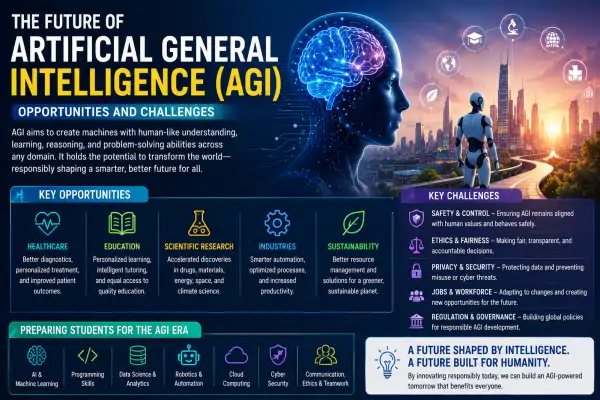
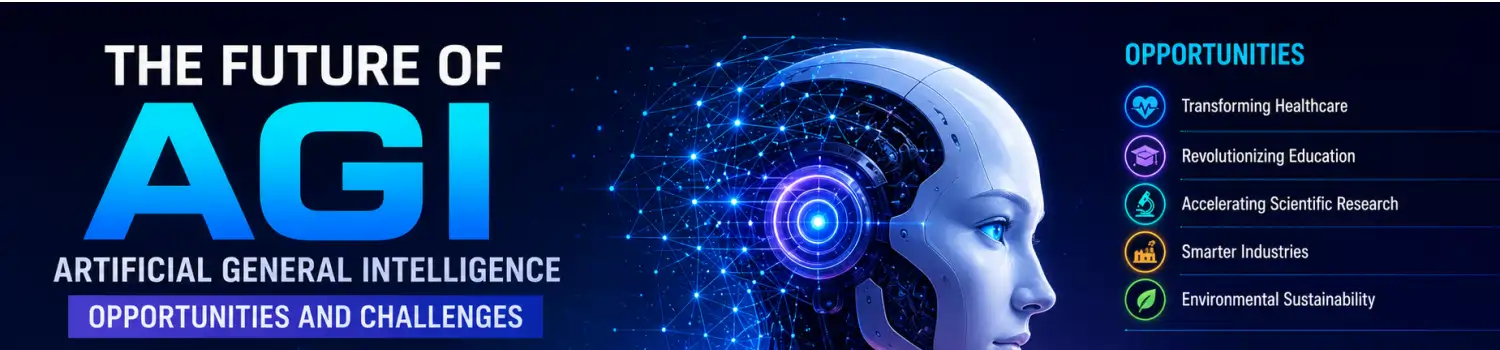
In healthcare, AGI could analyse medical records, interpret diagnostic images, recommend personalised treatments, and assist doctors in detecting diseases earlier, improving both accuracy and patient outcomes.
In education, intelligent learning systems could personalise lessons according to each student’s strengths, weaknesses, and learning pace while providing continuous guidance and adaptive assessments.
AGI could also accelerate scientific research by analysing enormous datasets, identifying patterns, and supporting discoveries in areas such as drug development, renewable energy, climate science, advanced materials, and space exploration.
Industries including manufacturing, agriculture, logistics, transportation, and finance could benefit from highly intelligent automation that improves productivity, reduces waste, and enhances operational efficiency.
Environmental sustainability is another promising area where AGI could support disaster prediction, optimise renewable energy systems, improve water resource management, monitor biodiversity, and assist governments in reducing carbon emissions.
Career Opportunities for Engineering Students
As AGI research progresses, demand for skilled professionals is expected to increase across several disciplines. Career opportunities may include AGI Research Engineer, Machine Learning Engineer, AI Systems Architect, Robotics Engineer, Data Scientist, AI Safety Engineer, Cognitive Computing Specialist, Human-AI Interaction Designer, and AI Ethics Consultant.
Students who develop strong foundations in programming, mathematics, machine learning, and analytical thinking will be well positioned to contribute to these emerging fields.
Challenges of AGI
Despite its enormous potential, AGI presents significant technical, ethical, and societal challenges.
One of the greatest concerns is safety and control. Researchers must ensure that AGI systems consistently act in ways that align with human values and avoid unintended consequences.
Ethical decision-making presents another challenge. Questions regarding fairness, transparency, accountability, and bias become increasingly important as intelligent systems participate in decisions that directly affect people’s lives.
Privacy and cybersecurity are equally critical because AGI systems may process vast amounts of sensitive personal and organisational information. Protecting this data against misuse and cyber threats will remain a major priority.
The widespread adoption of AGI may also transform employment. While automation could reduce demand for certain repetitive jobs, it is expected to create entirely new professions requiring advanced technical knowledge and continuous upskilling.
Finally, effective regulation and governance will require collaboration among governments, researchers, industries, and international organisations to ensure AGI is developed responsibly and benefits society as a whole.
Responsible Development of AGI
Technological progress alone is not sufficient to ensure the successful adoption of AGI. Responsible innovation must remain central to its development.
Researchers emphasise ethical AI principles, transparency, human oversight, privacy protection, fairness, robust cybersecurity, and international cooperation. Building trustworthy AI systems will help maximise the benefits of AGI while reducing potential risks to individuals and society.
Preparing for the AGI Era
Engineering students can prepare for the future by developing expertise in Artificial Intelligence, Machine Learning, Deep Learning, Data Science, Python programming, Cloud Computing, Robotics, Cybersecurity, and Large Language Models (LLMs).
However, technical knowledge alone will not be enough. Communication, creativity, teamwork, ethical reasoning, adaptability, and lifelong learning will continue to distinguish successful professionals in an increasingly AI-driven world.
Conclusion
Artificial General Intelligence represents one of the most ambitious goals in modern computing. Although it remains an active area of research, its potential to transform healthcare, education, scientific discovery, environmental sustainability, and industrial innovation is immense.
At the same time, AGI raises important questions about ethics, privacy, security, governance, and the future of work. Addressing these challenges responsibly will be just as important as advancing the underlying technology.
For today’s engineering students, AGI is not merely a future concept—it is an opportunity to become the innovators, researchers, and leaders who will help shape the next generation of intelligent technologies. By combining strong technical skills with ethical responsibility and a commitment to continuous learning, they can contribute to an AI-powered future that benefits humanity.