 Author: Department of Civil Engineering
Introduction
Permafrost foundation engineering is among the most challenging fields within civil engineering. Unlike conventional construction, the primary challenge is not only supporting structural loads but also understanding the changing thermal behaviour of the ground. Engineers working in Arctic and other cold regions know that frozen soil is not permanently stable; it is continually influenced by climate change, construction activities, and environmental conditions.
For students aspiring to become successful civil engineers, understanding these real-world challenges is just as important as mastering classroom concepts. Choosing the right civil engineering programme can provide both the academic knowledge and practical exposure required to design safe, resilient infrastructure in demanding environments.
The Core Challenge: A Thermal Problem Before a Structural One
Traditional foundation design focuses on soil mechanics, including bearing capacity, settlement, and shear strength. Permafrost, however, introduces an additional and equally important factor—temperature.
The construction of heated buildings, roads, or even the removal of vegetation can disturb the thermal balance of frozen ground. Once ice-rich soil begins to thaw, its strength decreases significantly, leading to differential settlement and structural instability.
Modern civil engineers must therefore combine principles of geotechnical engineering with thermal engineering to develop foundation systems that remain stable over their intended service life.
Students enrolled in quality civil engineering programmes gain exposure to subjects such as soil mechanics, foundation engineering, environmental engineering, and infrastructure planning, all of which prepare them to address these complex challenges.
Climate Change Is Redefining Foundation Design
One of the greatest concerns facing engineers today is that historical design assumptions are becoming increasingly unreliable.
Ground temperatures across many permafrost regions continue to rise, causing the active layer—the portion of soil that freezes and thaws annually—to become progressively deeper. As a result, engineers must account for changing ground conditions throughout a structure’s lifespan.
Some of the major engineering challenges include:
- Foundations designed for a 50-year service life may encounter unexpected thaw conditions much earlier.
- Reduced adfreeze bond strength can affect the long-term performance of pile foundations.
- Passive cooling systems such as thermosyphons are becoming essential rather than optional.
- Continuous ground monitoring is increasingly important for ensuring long-term structural safety.
These developments demonstrate why future civil engineers need strong analytical, research, and computational skills alongside traditional engineering knowledge.
Figure 1. Pile foundation behaviour in permafrost, illustrating load transfer, anchorage depth, and the influence of the active layer on foundation performance.
(Insert Figure 1 here.)
Common Foundation Solutions and Their Limitations
- Pile Foundations
Pile foundations remain one of the most reliable solutions in permafrost regions because they transfer structural loads to deeper frozen layers. However, rising ground temperatures can weaken the frozen bond surrounding the piles, reducing their long-term effectiveness.
- Passive Cooling Systems
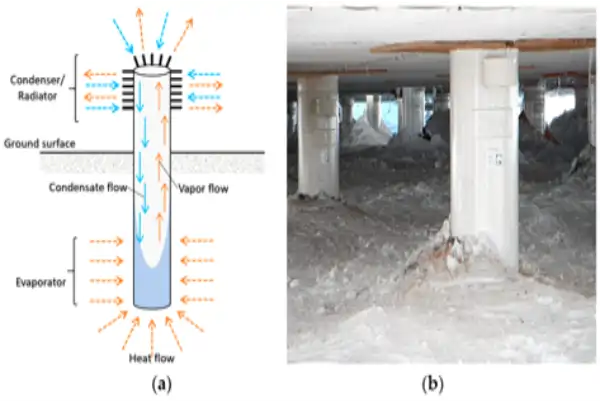
Thermosyphons and air-convection embankments help preserve frozen ground beneath structures. Although highly effective, these systems require periodic inspection and long-term maintenance.
- Elevated Structures
Elevating buildings above the ground reduces heat transfer and helps preserve natural ground temperatures. While environmentally beneficial, this approach generally increases construction costs.
- Adjustable Foundation Systems
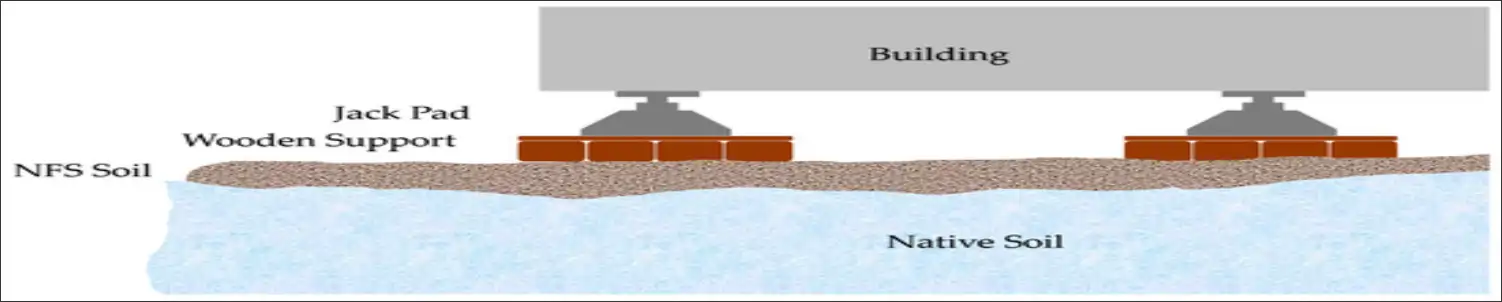
Adjustable jacking systems allow engineers to re-level buildings affected by differential settlement. Although they help manage the effects of thawing, they do not address its underlying cause.
Understanding both the advantages and limitations of these approaches is an essential component of modern civil engineering education.
Sustainability in Permafrost Engineering
Sustainable construction in cold regions focuses on preserving the natural thermal balance rather than continually correcting its disruption.
Good engineering practices include:
- Minimising disturbance to natural vegetation.
- Designing elevated structures wherever feasible.
- Using gravel pads to reduce heat transfer.
- Installing monitoring systems for early detection of settlement.
- Preferring passive cooling technologies over energy-intensive mechanical alternatives.
These strategies not only improve environmental performance but also reduce long-term maintenance and lifecycle costs.
The Importance of Site Investigation
One of the biggest challenges in permafrost engineering is the limited availability of long-term site-specific performance data.
Many projects still rely on regional averages rather than detailed temperature monitoring because of budget constraints. However, every construction site behaves differently, making comprehensive geotechnical investigations essential before foundation design begins.
This highlights the importance of practical laboratory work, field surveys, geotechnical testing, and industry exposure in engineering education.
Why Quality Engineering Education Matters
Complex foundation projects require engineers with knowledge of:
- Soil mechanics
- Foundation engineering
- Structural analysis
- Environmental engineering
- Construction management
- Climate-resilient infrastructure
- Computer-aided engineering tools
A reputed civil engineering institution provides students with experienced faculty, modern laboratories, practical learning opportunities, and exposure to real engineering problems. Industry interaction, internships, and placement support further prepare graduates for successful professional careers.
Figure 2. Passive cooling using thermosyphons and an example of elevated foundation systems designed to maintain frozen ground beneath structures.
(Insert Figure 2 here.)
Civil Engineering After 12th: Building the Future
For science students considering civil engineering after Class 12, the discipline offers diverse opportunities in structural engineering, transportation engineering, geotechnical engineering, environmental engineering, smart cities, and sustainable infrastructure development.
From designing highways and bridges to developing climate-resilient foundations in permafrost regions, civil engineers play a vital role in creating infrastructure that supports communities while adapting to changing environmental conditions.
Conclusion
Permafrost engineering teaches one of civil engineering’s most important lessons: successful foundation design depends not only on understanding the ground beneath a structure but also on anticipating how that ground may change over time. Historical data alone is no longer sufficient. Modern engineers must combine advanced analysis, sustainable design, continuous monitoring, and innovative construction techniques to create resilient infrastructure.
For aspiring civil engineers, selecting a strong educational programme is the first step towards developing the technical expertise needed to solve these global engineering challenges. With the right combination of theoretical knowledge, laboratory experience, and industry exposure, future engineers will be well prepared to design safer, more sustainable, and climate-resilient infrastructure for generations to come.