 Author: Department of Computer Science & Engineering
Introduction
Becoming a full stack developer is not about learning every programming language or framework mentioned online. Instead, it is about developing a clear understanding of how modern web applications function—from the moment a user interacts with a browser to the processing of information on a server and its storage in a database before the response is returned.
A structured learning path helps students build strong fundamentals while avoiding the confusion of jumping between multiple technologies. This roadmap outlines the essential stages of becoming a full stack developer, progressing from basic web development concepts to building and deploying real-world applications.
What Does Full Stack Development Mean?
A full stack developer is capable of working on both the front end, which users see and interact with, and the back end, where application logic, databases and business processes are managed.
Although many professionals eventually specialise in either front-end or back-end development, understanding both layers enables developers to build complete applications and troubleshoot issues that span multiple components of a system.
Stage 1: Front-End Foundations
Every full stack journey begins with the core technologies of the web:
- HTML for creating page structure and semantic content
- CSS for styling, layouts and responsive design
- JavaScript fundamentals, including the DOM, events, asynchronous programming and the Fetch API
Students should resist the temptation to learn a framework before mastering these fundamentals. Frameworks are built upon HTML, CSS and JavaScript, and a solid understanding of these technologies makes debugging and problem-solving much easier.
Stage 2: Version Control
Version control is an essential skill for every software developer. Git enables individuals and teams to manage source code efficiently, track changes and collaborate on projects.
Students should learn how to:
- Create meaningful commits
- Work with branches
- Resolve merge conflicts
- Use pull requests
- Collaborate through GitHub or GitLab
Developing these habits early prepares students for professional software development environments.
Stage 3: Learn a Front-End Framework
Once the fundamentals are well established, students should choose one modern front-end framework and gain proficiency before exploring others.
Popular choices include:
- React – widely adopted with a large ecosystem and excellent employment opportunities.
- Vue – known for its simplicity, flexibility and beginner-friendly documentation.
- Angular – a comprehensive framework commonly used in large enterprise applications.
Rather than learning several frameworks superficially, students benefit more from mastering one thoroughly.
Stage 4: Back-End Development and APIs
The back end provides application logic, processes requests and communicates with databases. Students should learn to build servers, define routes and create REST or GraphQL APIs that connect seamlessly with the front end.
Popular technology stacks include:
- Node.js with Express
- Python with FastAPI or Django
- Java with Spring Boot
- C# with .NET
Each provides a strong foundation for developing scalable and secure applications.
Stage 5: Databases
Every practical application requires reliable data storage. Students should understand the differences between relational and non-relational databases while learning to write queries before relying entirely on Object Relational Mapping (ORM) tools.
Key technologies include:
- SQL databases such as PostgreSQL and MySQL
- NoSQL databases including MongoDB and Redis
- ORM frameworks such as Prisma, SQLAlchemy and Sequelize
Understanding data modelling is just as important as learning database software.
Stage 6: Authentication and Security
As applications begin storing user information, security becomes a fundamental requirement rather than an optional feature.
Students should understand:
- Password hashing
- Session- and token-based authentication (JWT and OAuth)
- Input validation
- HTTPS
- Protection against SQL injection and Cross-Site Scripting (XSS)
Building secure applications should be considered from the earliest stages of development.
Stage 7: Testing and DevOps
Professional software development extends beyond writing functional code. Applications should be tested, automated and maintained effectively.
Students should become familiar with:
- Unit and integration testing
- Docker containerisation
- Continuous Integration and Continuous Deployment (CI/CD) pipelines
Automation improves software quality and enables reliable deployment.
Stage 8: Deployment
A project is complete only when users can access it.
Developers should learn how to deploy front-end applications using platforms such as Vercel or Netlify, while hosting back-end services on platforms such as Render, Railway, AWS or private servers.
Understanding environment variables, monitoring tools and application maintenance is equally important for managing production systems.
Image 1: The full stack development lifecycle—from front-end design and back-end development to databases, deployment and cloud hosting.
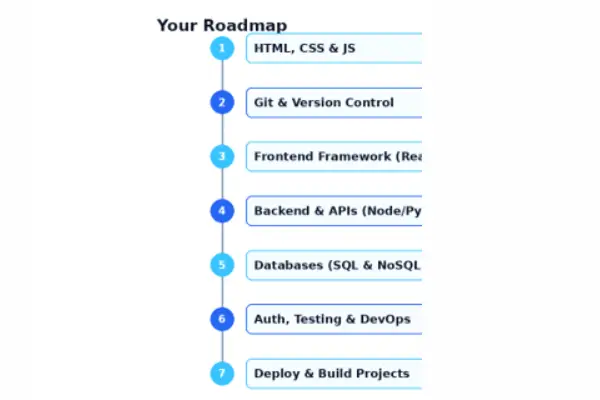
Roadmap at a Glance
| Stage | Core Skills and Technologies |
|---|---|
| Front-end foundations | HTML, CSS, JavaScript, responsive design |
| Front-end framework | React, Vue or Angular |
| Version control | Git, GitHub/GitLab, branching workflows |
| Back-end development | Node.js, Express, Django, FastAPI, Spring Boot or .NET |
| Databases | PostgreSQL, MySQL, MongoDB, Redis and ORMs |
| Authentication & security | JWT, OAuth, password hashing, HTTPS and input validation |
| Testing & DevOps | Unit testing, integration testing, Docker and CI/CD |
| Deployment | Cloud hosting, monitoring and application scaling |
How to Progress Successfully
Students can build their expertise by following a structured approach:
- Begin with a simple website using only HTML, CSS and JavaScript.
- Use Git for every project from the very beginning.
- Choose one front-end framework and one back-end technology stack before exploring additional tools.
- Develop a complete full stack project that includes the front end, back end, database and deployment.
- Add automated testing and a CI/CD pipeline once the application is functional.
- Deploy the project publicly, continue improving it and learn from practical experience.
Conclusion
Full stack development is a continuous learning journey that combines creativity, technical expertise and problem-solving. Rather than trying to master every available technology, students should focus on building strong fundamentals and progressing systematically through each stage of development.
By understanding how front-end interfaces, back-end services, databases, security and deployment work together, aspiring developers can build scalable, secure and user-friendly applications. With consistent practice, practical projects and a commitment to continuous learning, students can prepare themselves for rewarding careers in modern software development.