Author: Department of Computer Science & Engineering
Introduction
Choosing the next programming language to learn can be challenging, particularly when new technologies and frameworks emerge every year. Fortunately, a small group of programming languages continues to dominate industry demand, developer surveys and employment opportunities. Selecting the right language depends not only on current trends but also on career goals and the type of software you wish to develop.
The following languages remain among the most valuable choices for students and aspiring software professionals in 2026.
- Python
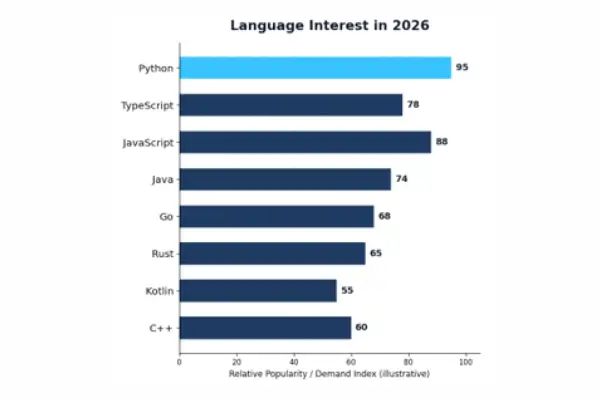
Python continues to be one of the most versatile and beginner-friendly programming languages. Its simple syntax makes it accessible to new programmers, while its extensive ecosystem of libraries—including Pandas, Scikit-learn, PyTorch, Django and FastAPI—makes it indispensable for professionals.
Python is widely used in:
- Artificial Intelligence and Machine Learning
- Data Science and Analytics
- Back-end Web Development
- Automation and Scripting
For students seeking a single language with broad career opportunities, Python remains an excellent starting point, particularly as AI and data-driven technologies continue to expand.
- JavaScript and TypeScript
JavaScript remains the foundation of modern web development, powering virtually every interactive website. However, TypeScript has become the preferred choice for many professional development teams because its static typing improves code quality and simplifies the management of large applications.
- JavaScript: Essential for browser applications, Node.js development and frameworks such as React and Vue.
- TypeScript: Widely adopted for large-scale front-end and full stack applications due to improved maintainability and reliability.
- Java
Java continues to be one of the most trusted programming languages for enterprise software, Android development and large-scale business applications. Its reliability, security and scalability have ensured sustained demand across industries, making it a strong choice for students seeking long-term career stability.
- Go (Golang)
Go has become increasingly popular in cloud computing, distributed systems and DevOps. Its straightforward syntax, fast compilation and excellent support for concurrent programming make it well suited for cloud-native applications and modern backend services.
- Rust
Rust continues to gain recognition for systems programming, offering high performance together with strong memory safety. Although it has a steeper learning curve than many other languages, Rust helps developers avoid common programming errors while building secure and efficient software.
- Kotlin and Swift
For mobile application development, Kotlin and Swift remain the leading choices.
- Kotlin is the preferred language for Android application development and is widely used in modern mobile software projects.
- Swift is Apple’s primary language for developing iOS applications and provides a modern, developer-friendly alternative to Objective-C.
- C and C++
These foundational languages continue to play an important role in software development. C++ is widely used for game development, embedded systems, robotics, autonomous vehicles and high-performance computing because of its speed and low-level control over hardware resources.
Learning C or C++ also provides a deeper understanding of how software interacts with computer systems, making it easier to learn additional programming languages later.
- C#
Supported by Microsoft’s .NET ecosystem, C# remains a popular choice for enterprise software, desktop applications and game development, particularly with the Unity game engine. Its versatility continues to make it valuable across multiple technology domains.
Image 1: Modern software development relies on programming languages designed for web applications, artificial intelligence, cloud computing, mobile development and systems engineering.
Choosing the Right Language
Rather than attempting to learn every programming language, students should select one that aligns with their career aspirations.
| Career Goal | Recommended Language |
|---|---|
| Artificial Intelligence, Machine Learning and Data Science | Python |
| Front-end and Full Stack Web Development | JavaScript / TypeScript |
| Enterprise Software and Android Development | Java or Kotlin |
| Cloud Computing and DevOps | Go |
| Systems Programming and High Performance Computing | Rust or C++ |
| iOS Application Development | Swift |
| Game Development | C++ or C# |
Getting Started
Students can make steady progress by following a structured learning approach:
- Choose one area of interest, such as Artificial Intelligence, web development, mobile applications or systems programming.
- Build a small but complete project using the chosen language and understand every design decision involved.
- Learn a second language only after becoming comfortable with the first.
- Stay updated with developments within the chosen technology ecosystem rather than attempting to follow every programming trend.
Conclusion
Programming languages are the foundation of modern software development, but selecting the right one depends on individual interests and career objectives rather than short-term popularity. Languages such as Python, JavaScript, Java, Go, Rust, Kotlin, Swift, C++ and C# continue to offer excellent opportunities across emerging technologies and established industries.
For aspiring software professionals, success comes not from learning the greatest number of languages but from developing a strong understanding of programming fundamentals and applying them to solve real-world problems. By mastering one language thoroughly before expanding into others, students can build the technical confidence and adaptability needed for successful careers in the rapidly evolving technology industry.